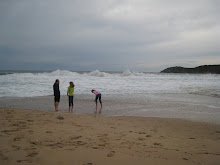
It has been raining, raining, raining for the past three weeks. We will have two or three days of solid rain, and then a day or two of sun (which is good: I can hang the laundry out to dry), and then more rain. One night last weekend the rain fell so hard that it woke us up in the middle of the night.
Rain is different when you live in the country, or in the almost-country, as we do. Maybe what I should say is this: when you live in the city, you live with pavement. Water runs off the concrete and into gutters and then it is gone, and you walk along under your umbrella or, if you forgot that, under the shop awnings, and you try not to step in puddles. But aside from puddles and damp shoes, you are insulated from the wetness of the rain. The water goes away. It flows downhill, or, at any rate, into the sewer and out of your life. (Assuming, of course, that it doesn't enter your basement or your attic or your garage: but those are events that are outside of the ordinary rain experience.)
Here the rain is a force to reckon with. Not just the rain itself, falling so hard that it wakes us out of deep sleep, but the results of the rain. Rain is a cause and has effects. Our parking area is up the hill from our house and uphill from our lane--uphill in the sense of a vertical turn from the lane up and then only slightly less gradually down. Above our parking area is a once-road that is now a path leading to the village. When it rains as it has been doing, the path becomes a stream. You could play poohsticks in its current.
Our parking area and driveway are not paved; M. LaChaix, bless him, thought that pebbles would be ever so much more rustique. Well, rustic it is, and so is the inside of my car, filled with pebbles and clay that have stuck to our shoes. And so is the inside of the house: I have not yet found the doormat that will rid shoes and paws of mud and pebbles. The house is lacking in gutters--plus rustique, encore--and so when I and my muddy shoes arrive at the back door and fumble with my keys, large drops of water fall from the top of the house down the back of my jacket.
There's the laundry factor as well, with the rain. We have a clothes dryer, but it is not terribly efficace. It spins the clothes around dutifully for five or ten minutes, and then it takes a break; then starts in again; then, time for another coffee. When it eventually stops, the clothes are not so much dry as they are less wet. I haven't figured out yet if there is a button on the dryer that I could push that means, yes, REALLY DRY, please. What all that means--that and the cost of electricity and the mortgage crisis and the war in Iraq and the melting ice caps and the bottomless fall of the dollar against the euro--is that I hang our clothes outside to dry, which, thanks be to the Mediterranean sun, they do, quickly. But when it rains: ah. Then what. Then I hang the clothes in the basement, on the line that Olivier put up for me, and, two or three days later, they are mostly dry. It's given me an entirely new historical perspective. There's a dissertation out there that has yet to be written on The Problem of Wet Laundry in Early Modern Europe.
Tuesday morning I received a welcome jolt of perspective on my troubles with the rain. The gardener from the villa below ours on the hill knocked on the door.
Il y a un petit ruisseau, there is a little stream, he said, that is flowing from the terrace at the bottom of your garden down the hill into the olive grove and, after that, into the vineyard.
What he did not say, because he did not need to, was this: the petit ruisseau was issuing forth from the place where our epandage, our leechfield, lies. The little stream was not some natural spring flowing forth because of the excess rain. The stream was flowing out of our septic system.
I went and found Olivier. He went to the bottom of our garden and stepped down into the public right-of-way path that runs between our us and the next villa. The gardener was waiting. I stood under our olive trees and looked down at the two men as they talked and gestured, and I looked at the stream. This ruisseau had current, too, though you might not want to play poohsticks in it. It was several feet wide, and flowed from a hole in the side of the terrace that supports the end of our garden, across the seriously muddy path, under a half dozen olive trees, and then found a level spot under several rows of grape vines, where the runoff from the leechfield was pooling into several giant puddles. If they were to press these grapes, they could call the wine Cote d'Epandage, and sell it someplace where no one speaks French septic.
For those of you following along at home, you will remember this is not the first difficulty that our septic system has wrought. Olivier and the gardener stood and conferred, and I heard Olivier say that no, this time, after they had entirely reconstructed the leechfield, everything was, or should be, up to code, tout en regle. But still: should there be this much water flowing out from the system? And was it really for the best that it flow into the vineyard below?
The next morning the rain was back, and I saw Olivier go down to the bottom of the garden and meet a man in the path. They stood under their umbrellas for a while and watched the water flow. I asked him later if the plumber had come about the septic.
The plumber? He looked blank.
I reminded him. I saw you talking to him this morning, next to the ruisseau.
Ah, yes. That was not the plumber, Olivier smiled. That was the geologist.
We have graduated from plumbers to geologists. I don't know what can be done about our stream. There's been a lot of rain, and the leechfield can only hold so much water, and after that, well, water flows downhill. Downhill, in our case, across a public path and into a vineyard. But if anyone could make water flow uphill, then I'm sure it would be a Frenchman.
Friday, January 18, 2008

Monday, January 14, 2008
Skiing
We live within an hour or two of several ski resorts--and not just bunny slopes, places where the Olympics have been held within recent memory. C. and the girls have gotten themselves all outfitted with ski gear and went off on New Year's Ever for a successful day on the slopes.
Yesterday morning they went off again. At about noon I answered the phone:
Hi, Mommy. E. had been deputized to call.
How's the skiing? I pictured them mid-mountain at the resort.
Oh, we didn't go skiing because of the avalanche. We went for a hike instead. We're going to have lunch now. Bye!
And then a dial tone. I sat down for a minute or two. Evidently they were all fine. Had the avalanche happened on the road? At the resort? On the slope as they were skiing down it? E.'s brevity, while admirable, did leave some room for questions.
Turns out that the entire resort was shut down because of an avalanche; the road itself was closed. They tried to go to another resort instead, but so did everyone else. The traffic was impossible. So they went for a hike, and stopped off at an auberge for French Sunday lunch (picture considerably more than a slice of pizza), and came home early. Tired, satisfied, with another story to tell. And if I had just a little more grey hair--it hadn't occured to me, before, to put avalanches on my list of maternal cares--well, I think it was worth it. Probably.
Yesterday morning they went off again. At about noon I answered the phone:
Hi, Mommy. E. had been deputized to call.
How's the skiing? I pictured them mid-mountain at the resort.
Oh, we didn't go skiing because of the avalanche. We went for a hike instead. We're going to have lunch now. Bye!
And then a dial tone. I sat down for a minute or two. Evidently they were all fine. Had the avalanche happened on the road? At the resort? On the slope as they were skiing down it? E.'s brevity, while admirable, did leave some room for questions.
Turns out that the entire resort was shut down because of an avalanche; the road itself was closed. They tried to go to another resort instead, but so did everyone else. The traffic was impossible. So they went for a hike, and stopped off at an auberge for French Sunday lunch (picture considerably more than a slice of pizza), and came home early. Tired, satisfied, with another story to tell. And if I had just a little more grey hair--it hadn't occured to me, before, to put avalanches on my list of maternal cares--well, I think it was worth it. Probably.
Sunday, January 13, 2008
Scenes from the life
The other day I went with the English ladies to Frejus, a town on the coast an hour or so from here, and we looked in at the cathedral while we were there. The Cathedrale St-Leonce de Frejus was built in the Middle Ages on the site of an earlier church, which was, in turn, built on the site of a Roman temple, and chances are good that the Romans just threw up some columns on the site of a local shrine that was already there when they pulled into town. It is a textbook example, to my only slightly schooled eye, of Romanesque architecture. That means, for those of you who have left your art history textbooks in the next room, that the arches are round instead of pointy. Think about the front of Notre Dame, or, for that matter, of Duke Chapel: pointy arches = Gothic architecture, which came into fashion a couple of centures after Frejus' cathedral was already open for business.
I took a turn around the nave--the mandatory nativity was still set up, with Mary and Joseph and the baby in their stable tranquilly receiving the three kings, some shepherds, and local Frejusian dignitaries dressed in their provencal best--and then there were monuments to the fallen, and monuments to bishops, and a few large paintings made in the 1500s or 1600s. It was one of these last that caught my eye: an unsigned Scènes de la vie de la Vierge, Scenes from the Life of the Virgin.
The large oil canvas shows Mary seated at the center front, with the baby Jesus in her lap. Just behind Mary, over her left shoulder, an elderly Joseph is reclining on a fainting couch. At her right, her kinswoman and friend Elizabeth is perched, with her little boy, John the Baptist, standing in front of her. Behind Elizabeth a couple of ladies in sixteenth-century court gowns are looking on, presumably because they are the ones who paid for this painting; overhead, assorted cherubim flit through the skies. It's a standard okay church painting, better than some but a long way from Raphael.
I started to walk on by, but then looked back. Mary was doing something I don't think I've ever seen her do: she was reading. Or trying to, anyway. Jesus, at about seven months, was squirming in her lap, wearing nothing but his diaper--it had been that kind of day--and Mary was using her left hand to hold him in her lap and prevent him from reaching over and grabbing a big handful of John the Baptist's hair. Joseph, over her shoulder, was leaning forward with his left hand extended, about thirty seconds away from asking if she had seen his keys and wallet. Elizabeth, on the other side, was leaning up to Mary's ear; she and John the Baptist, who, at about 18 months, was clearly in his dressing up like a lion phase, had just looked in so that Elizabeth could tell Mary what she had heard down at the well. And John the Baptist was, with one hand, reaching up to pull Jesus down to the floor while, with his foot, he threatened to kick over Mary's basket of mending.
And, in the midst of all this, Mary had a book in her right hand. She was holding it open just in front and to the right of her face, and was looking, not at Joseph or Jesus or Elizabeth or John, but at the pages. She wasn't showing the book to Jesus--she wasn't the instructive, devout, listen-up sinners kind of Mary that so often turns up in portraits--she was reading, silently, to herself, for herself. And the look on her face said: just let me finish this paragraph. I'll find your keys and get the baby dressed and I'll do the mending and go in the kitchen and make some tea for our visit, Elizabeth, and the boys can play together, but just let me finish this one paragraph first.
Scenes from the life, indeed. I wonder if women, at least, those who were lucky enough to know how to read, nudged each other four hundred years ago when they saw this painting. The English ladies and I stood in front of the painting and laughed, and talked about it on our way home that afternoon. It was ever thus: we all had known moments exactly like that, when the whole world seemed to be clamoring for our attention and we just wanted another moment or two to ourselves.
I like to picture reading Mary going to the Nazareth public library and browsing the shelves, and coming home every week with a new stack of books to keep her brain busy while she looked after her little boy. And I like that she was finishing that paragraph.
I took a turn around the nave--the mandatory nativity was still set up, with Mary and Joseph and the baby in their stable tranquilly receiving the three kings, some shepherds, and local Frejusian dignitaries dressed in their provencal best--and then there were monuments to the fallen, and monuments to bishops, and a few large paintings made in the 1500s or 1600s. It was one of these last that caught my eye: an unsigned Scènes de la vie de la Vierge, Scenes from the Life of the Virgin.
The large oil canvas shows Mary seated at the center front, with the baby Jesus in her lap. Just behind Mary, over her left shoulder, an elderly Joseph is reclining on a fainting couch. At her right, her kinswoman and friend Elizabeth is perched, with her little boy, John the Baptist, standing in front of her. Behind Elizabeth a couple of ladies in sixteenth-century court gowns are looking on, presumably because they are the ones who paid for this painting; overhead, assorted cherubim flit through the skies. It's a standard okay church painting, better than some but a long way from Raphael.
I started to walk on by, but then looked back. Mary was doing something I don't think I've ever seen her do: she was reading. Or trying to, anyway. Jesus, at about seven months, was squirming in her lap, wearing nothing but his diaper--it had been that kind of day--and Mary was using her left hand to hold him in her lap and prevent him from reaching over and grabbing a big handful of John the Baptist's hair. Joseph, over her shoulder, was leaning forward with his left hand extended, about thirty seconds away from asking if she had seen his keys and wallet. Elizabeth, on the other side, was leaning up to Mary's ear; she and John the Baptist, who, at about 18 months, was clearly in his dressing up like a lion phase, had just looked in so that Elizabeth could tell Mary what she had heard down at the well. And John the Baptist was, with one hand, reaching up to pull Jesus down to the floor while, with his foot, he threatened to kick over Mary's basket of mending.
And, in the midst of all this, Mary had a book in her right hand. She was holding it open just in front and to the right of her face, and was looking, not at Joseph or Jesus or Elizabeth or John, but at the pages. She wasn't showing the book to Jesus--she wasn't the instructive, devout, listen-up sinners kind of Mary that so often turns up in portraits--she was reading, silently, to herself, for herself. And the look on her face said: just let me finish this paragraph. I'll find your keys and get the baby dressed and I'll do the mending and go in the kitchen and make some tea for our visit, Elizabeth, and the boys can play together, but just let me finish this one paragraph first.
Scenes from the life, indeed. I wonder if women, at least, those who were lucky enough to know how to read, nudged each other four hundred years ago when they saw this painting. The English ladies and I stood in front of the painting and laughed, and talked about it on our way home that afternoon. It was ever thus: we all had known moments exactly like that, when the whole world seemed to be clamoring for our attention and we just wanted another moment or two to ourselves.
I like to picture reading Mary going to the Nazareth public library and browsing the shelves, and coming home every week with a new stack of books to keep her brain busy while she looked after her little boy. And I like that she was finishing that paragraph.
Monday, January 7, 2008
Strangers
The day before New Year's Eve we went to do our shopping. It was cold and rainy, and the barometric pressure was changing; my personal barometer, the one that I carry in my sinuses, was throbbing hard with the effort of recalibrating. The grocery store was busy with extended families--grandparents who live here, parents and their children who had just arrived to spend New Year's--and with vacationers. (If someone is dressed for the city and has more than two bottles of alcohol, not wine, then he goes in the rented-a-house-and-came-down-for-the-holiday category.) From the atmosphere, any American would have deduced that snow was predicted. There was a sense of urgency, of buy it now, of stocking up. But there was no snow in the forecast--just more rain, and a fermeture exceptionelle for the holiday. New Year's Eve--la Reveillon--seems as much an event as Christmas Eve and Christmas Day; in fact, the stores are closed longer. And so the rush.
I left everyone in the grocery store and went next door to the bakery hoping for a little less jostling. The line was to the door. Strangers, mostly: a well-turned out woman in city shoes ordering all the pots de creme in stock in clipped, abrupt Parisian French; a German man pointing to the eclairs; English visitors ordering one of most everything. There were one or two locals, an elderly lady in her old cloth coat, sons or husbands who had run out for baguettes for Sunday lunch. Supplies were dropping; the bakery would close for the day within the hour. When it was my turn in line, the boulanger, my friend, took charge of me.
Ah, Washington. Ca va? He has taken to calling me Washington. Qu'est que vous voudriez? What would you like?
I ordered two baguettes and we both turned to look at the baguettes bin behind the cash register. Two overcooked loaves leaned in the corner, the only ones that remained.
The baker turned back to me. Do you have other errands to do? He checked his watch. The fresh bread will be ready in just a few minutes, you could come back...As he spoke, there was a commotion at the back of the shop, and the fresh bread came through the door. Our bakery does its baking up the hill, and so the fresh goods arrive several times a day by truck.
Ah, here it is now. The baker smiled. Vous voyez, madame, je pense toujours de vous. You see, madame, I am always thinking of you.
I smiled, handed over my coins, and took the baguettes, so warm that I felt their heat through my gloves.
Outside, I found C. He broke off the end of a baguette, tore it in half, and we walked back to the car in the rain eating bread that was half a hillside out of the oven. The weather was still changing--my sinuses still ached--but at least I was not a stranger. I belonged, in some fashion, more than the others, more, even, than the Parisian lady with her pots de creme. The baker, he is always thinking of me.
I left everyone in the grocery store and went next door to the bakery hoping for a little less jostling. The line was to the door. Strangers, mostly: a well-turned out woman in city shoes ordering all the pots de creme in stock in clipped, abrupt Parisian French; a German man pointing to the eclairs; English visitors ordering one of most everything. There were one or two locals, an elderly lady in her old cloth coat, sons or husbands who had run out for baguettes for Sunday lunch. Supplies were dropping; the bakery would close for the day within the hour. When it was my turn in line, the boulanger, my friend, took charge of me.
Ah, Washington. Ca va? He has taken to calling me Washington. Qu'est que vous voudriez? What would you like?
I ordered two baguettes and we both turned to look at the baguettes bin behind the cash register. Two overcooked loaves leaned in the corner, the only ones that remained.
The baker turned back to me. Do you have other errands to do? He checked his watch. The fresh bread will be ready in just a few minutes, you could come back...As he spoke, there was a commotion at the back of the shop, and the fresh bread came through the door. Our bakery does its baking up the hill, and so the fresh goods arrive several times a day by truck.
Ah, here it is now. The baker smiled. Vous voyez, madame, je pense toujours de vous. You see, madame, I am always thinking of you.
I smiled, handed over my coins, and took the baguettes, so warm that I felt their heat through my gloves.
Outside, I found C. He broke off the end of a baguette, tore it in half, and we walked back to the car in the rain eating bread that was half a hillside out of the oven. The weather was still changing--my sinuses still ached--but at least I was not a stranger. I belonged, in some fashion, more than the others, more, even, than the Parisian lady with her pots de creme. The baker, he is always thinking of me.
Wednesday, January 2, 2008
Christmas
Christmas lights began going up at the beginning of November, and I expect they will come down next week, when school starts again and the holidays are over. But what lights they have been. We have been used to fairly effulsive Christmas lights and attendant decorations in America, from the tasteful and restrained wreaths (with bows that match the sofa inside) of our city neighborhood to the nativities shaped out of chicken wire in parts of my hometown. And, always, the flourishes that decorate lampposts and line busy streets: bells, stars, candles, the bells always silver or gold, the stars always white, the candles generally yellow but occasionally venturing towards red or green. Everywhere we've lived in America the decorations have been about the same, like they are all turned out by some company in Kansas that uses the same designers as Hallmark, and all the designers have agreed on the same model of a Currier and Ives Christmas.
We are not in Kansas anymore. Every village has its own set of lights and its own interpretation of the holiday, and I have not seen any repeats. Valbonne, across the valley and over the hill, has strung white and blue stars across its narrow pedestrian streets; the white stars alternate lighting up with the blue. Along the main road there is a string of white light bulbs that swings between the plane trees, and a sign over the road that wishes all who pass beneath it Joyeuses Fetes. Biot, on the far side of the valley, went Valbonne one better: its illuminated sign across the main road reads: Le Village de Biot Vous Souhaite des Bonnes Fetes, while Mougins, home to a lot of English expats, chose Mougins Vous Souhaite Joyeux Noel Happy Christmas, for those non-French speakers who don't have time to consult a dictionary while driving.
Up the hill in Le Rouret, the church is outlined in blue lights and the sign between the church and the town hall is trimmed in quantities of white tinsel: Joyeuses Fetes, but this time in block letters instead of the more staid and evidently traditional cursive. Opio, our nearest village, chose the tasteful, understated 2008 in lights over the first rond point, and Bonnes Fetes over the second. The Opio church tower is outlined in lights, and, at the top of the tower, there is a--probably it is a star, but really, it looks like an asterisk, or an enormous jack from a child's game, and each spoke lights up in turn until they are all lit, and then it flashes a few times before going dark and beginning again.
The merchants at the rond point where we are regular customers all pooled together for their decorations. They took plastic mineral water bottles and cereal boxes and wrapped them in red and gold shiny paper, and strung them from the evergreens. They covered the plane trees with blue flashing lights and fat red tinsel garlands. They hung Santas from every possible place-- windows, lamp posts, archways--an addition that is somewhat startling if your (American) Santa climbs down the chimney from the rooftop instead of up the house on a rope or a ladder, as does Pere Noel. When the nylon Santa dolls, clinging to their ropes or ladders, twist in the wind, it is hard not to think of Billie Holiday singing Strange Fruit, and if you are looking for cultural dislocation, well, there you are. Figures of men hanging from lampposts, windowsills, sides of houses are just Santas in this part of the world, and, if someone lit a cross in their front yard, it might be for the light and warmth (I'll let you know at Easter).
The overall effect at our shops was of decorations done by slightly intoxicated preschoolers: irregular, awkward, asymmetrical, unselfconscious, joyous. Even the Santas. Wherever the merchants bought the first few Santas must have sold out, because they are all different, different material, different sizes, even different shapes. So I think that there was not a plan for this last July, or ten Julys ago. They went out and bought what they needed, when they needed it, and if they could get by without buying something, then they did. No Christmas decoration catalogue came in the mail from Kansas. No one with an MBA did a study that showed that we would all spend more money if there was an extra Pellegrino mineral water bottle wrapped in shiny red paper and dangling from a tree. Decorating for Christmas is an American import, I know, but it has changed into something very French: beauty and decoration for their own sake, not for profit.
All season the village decorations have been reminding me of something and finally last night I figured out what it was. The girls had gone to a friend's house for a slumber party, and C. and I went looking for a restaurant open on New Year's night. We walked down a street that was decorated in white and gold and red squiggles, all lit up and bobbing in the breeze, and I thought of Whoville. Such an American connection to make: Dr. Seuss's Grinch. Whoville in the Christmas cartoon of my childhood was covered in just the sort of random, bizarre, brightly colored decorations as we have enjoyed for the past few weeks. The decorations are Seussian--Seussian gothic, maybe, if you include the Santas.
I had worried a little about putting on Christmas in a foreign country, away from all of our usual traditions, worried that it wouldn't feel like Christmas. But I think it worked. Family and friends who are family came, and we decorated and cooked and talked and ate and talked some more, which is what we always do, and, what was different, we hiked and went to museums and open-air markets. And on Christmas Eve we went outside and looked up at the stars and drank eggnog, and came inside and sang carols that we knew by heart. So we honored the holiday.
And, as I think back over it, our holiday itself seems Seussian. Without all the parties and shopping and rushing around that have been such a feature of Christmas, we celebrated anyway. I have always loved the ending of the Grinch. When the Whos gather around the tree in the village place and sing Welcome, Christmas! come this way, my eyes always well up. And here, in this strange new place, festooned with beribboned water bottles and Santas hanging from the lamp posts, I have felt like a Who: Welcome, Christmas! Bring your cheer. Welcome all Whos, far and near. Christmas Day will always be, just as long as we have we.
We are not in Kansas anymore. Every village has its own set of lights and its own interpretation of the holiday, and I have not seen any repeats. Valbonne, across the valley and over the hill, has strung white and blue stars across its narrow pedestrian streets; the white stars alternate lighting up with the blue. Along the main road there is a string of white light bulbs that swings between the plane trees, and a sign over the road that wishes all who pass beneath it Joyeuses Fetes. Biot, on the far side of the valley, went Valbonne one better: its illuminated sign across the main road reads: Le Village de Biot Vous Souhaite des Bonnes Fetes, while Mougins, home to a lot of English expats, chose Mougins Vous Souhaite Joyeux Noel Happy Christmas, for those non-French speakers who don't have time to consult a dictionary while driving.
Up the hill in Le Rouret, the church is outlined in blue lights and the sign between the church and the town hall is trimmed in quantities of white tinsel: Joyeuses Fetes, but this time in block letters instead of the more staid and evidently traditional cursive. Opio, our nearest village, chose the tasteful, understated 2008 in lights over the first rond point, and Bonnes Fetes over the second. The Opio church tower is outlined in lights, and, at the top of the tower, there is a--probably it is a star, but really, it looks like an asterisk, or an enormous jack from a child's game, and each spoke lights up in turn until they are all lit, and then it flashes a few times before going dark and beginning again.
The merchants at the rond point where we are regular customers all pooled together for their decorations. They took plastic mineral water bottles and cereal boxes and wrapped them in red and gold shiny paper, and strung them from the evergreens. They covered the plane trees with blue flashing lights and fat red tinsel garlands. They hung Santas from every possible place-- windows, lamp posts, archways--an addition that is somewhat startling if your (American) Santa climbs down the chimney from the rooftop instead of up the house on a rope or a ladder, as does Pere Noel. When the nylon Santa dolls, clinging to their ropes or ladders, twist in the wind, it is hard not to think of Billie Holiday singing Strange Fruit, and if you are looking for cultural dislocation, well, there you are. Figures of men hanging from lampposts, windowsills, sides of houses are just Santas in this part of the world, and, if someone lit a cross in their front yard, it might be for the light and warmth (I'll let you know at Easter).
The overall effect at our shops was of decorations done by slightly intoxicated preschoolers: irregular, awkward, asymmetrical, unselfconscious, joyous. Even the Santas. Wherever the merchants bought the first few Santas must have sold out, because they are all different, different material, different sizes, even different shapes. So I think that there was not a plan for this last July, or ten Julys ago. They went out and bought what they needed, when they needed it, and if they could get by without buying something, then they did. No Christmas decoration catalogue came in the mail from Kansas. No one with an MBA did a study that showed that we would all spend more money if there was an extra Pellegrino mineral water bottle wrapped in shiny red paper and dangling from a tree. Decorating for Christmas is an American import, I know, but it has changed into something very French: beauty and decoration for their own sake, not for profit.
All season the village decorations have been reminding me of something and finally last night I figured out what it was. The girls had gone to a friend's house for a slumber party, and C. and I went looking for a restaurant open on New Year's night. We walked down a street that was decorated in white and gold and red squiggles, all lit up and bobbing in the breeze, and I thought of Whoville. Such an American connection to make: Dr. Seuss's Grinch. Whoville in the Christmas cartoon of my childhood was covered in just the sort of random, bizarre, brightly colored decorations as we have enjoyed for the past few weeks. The decorations are Seussian--Seussian gothic, maybe, if you include the Santas.
I had worried a little about putting on Christmas in a foreign country, away from all of our usual traditions, worried that it wouldn't feel like Christmas. But I think it worked. Family and friends who are family came, and we decorated and cooked and talked and ate and talked some more, which is what we always do, and, what was different, we hiked and went to museums and open-air markets. And on Christmas Eve we went outside and looked up at the stars and drank eggnog, and came inside and sang carols that we knew by heart. So we honored the holiday.
And, as I think back over it, our holiday itself seems Seussian. Without all the parties and shopping and rushing around that have been such a feature of Christmas, we celebrated anyway. I have always loved the ending of the Grinch. When the Whos gather around the tree in the village place and sing Welcome, Christmas! come this way, my eyes always well up. And here, in this strange new place, festooned with beribboned water bottles and Santas hanging from the lamp posts, I have felt like a Who: Welcome, Christmas! Bring your cheer. Welcome all Whos, far and near. Christmas Day will always be, just as long as we have we.
Monday, December 31, 2007
La fosse septique
It started in the summer. We had been in the house for a few weeks when we began to notice, in the evenings at dusk when we were sitting outside on the front terrace, a smell. It came from the yard, and it was pungent and earthy. Not every night, but some nights. C. and I did not mention it to each other at first, because mentioning it to each other would mean that it was not in our imaginations. But, after a few weeks, we did own up to having smelled the smell, and then we began comparing notes.
It was not always the same strength, and seemed to wander a bit: sometimes stronger on the terrace than in the yard, sometimes stronger in the morning than in the evening. Another week or two and we confessed to each other that each of us had smelled it inside, as well, in the bathroom in the guest room. The room smelled at times like--well, like a sewer. Then one day one of us went downstairs to the basement and smelled it so strongly our eyes watered, and that was the day that we decided it was time to speak up.
I got out all of our French / English dictionaries and found that the lexicographers at most major presses do not see the need to discuss sewers in any useful detail. I had never in my previous life needed to talk at any length about sewers in English, and so figuring out how to do it in French meant starting from scratch. After comparing three printed and several more online dictionaries, the best phrase that I could come up with was mauvaises odeurs: bad smells. It did not seem, somehow, technical enough, but it was all I had to go on.
The next time M. LaChaix--Jules--trundled down our hill--it was August, and he and his family were in residence--I broached the topic with him. Sometimes outside at night and sometimes in the morning, we smell bad smells. And often in the chambre des invites there are bad smells. I hoped that he would understand that I was not talking about some bad yogurt.
A shadow crossed his tanned face. What kind of bad smells?
This was the response for which I had no French, and for which even my English, with my haute bourgeoisie Parisian landlord, would have had to rely heavily on euphemism. Since it was the middle of the day, I took him into the room in question and suggested that he smell for himself. He smelled nothing. Then we went downstairs. Still nothing. I was beginning to feel ridiculous--maybe we had been imagining it, maybe it had gone away on its own--and so, when Jules turned his attention to that day's growth of the wisteria that had been planted a few weeks before, and that he seemed to think would provide full shade on the terrace by the end of the summer if only we watered it enough, I let the matter rest. But before he went back up the terraces, he brought it up again. If you smell the bad smells again, tell me. It could be very expensive.
The bad smells were back that evening, and the next morning, and were strong enough in the guest room, where I had set up my desk, for me to move my computer to the kitchen table. This time when Jules came to smell he brought Olivier with him. We all stood around in the guest room breathing in through our noses, and this time we all smelled it. Jules and Olivier went into a huddle of rapid-fire French about the smell, going out to stand in the yard and gesture at various pipes and covers that I had seen Olivier working around. I lost the thread of their conversation after a sentence or two and wandered off, figuring that someone would fill me in later. They spent an hour or so coming in and out of the house, upstairs and downstairs, flushing toilets, turning on showers and baths, all the time gesticulating and talking and, when they saw me, looking as if there was nothing out of the ordinary happening.
M. Amavet, the plumber, came the next day. He was in his early 30s, a little plump, like he was still eating his mother's cooking every day at lunch, and very pink cheeks. His manner was courtly shading into unctuous: he bowed a little over my hand as he shook it, and then went off with Olivier and Jules to inhale here and there. Lots of gesturing and rapid French later, Jules found me and explained that it appeared that M. Amavet had routed some of the ventilation pipes for the plumbing into the basement instead of outside. That was the source of the difficulty, and M. Amavet would return the next day and rectify the error.
The next evening we were finishing dinner on the terrace when we smelled it again.
Didn't you say that the plumber came today to fix the smells? C. asked.
We looked at each other. When I saw Olivier the next morning, I told him the smells were still there. He frowned. But Amavet came yesterday to fix it.
I know. But we still smell the bad smells. More inhaling, more walking around.
This set the pattern for the next few weeks. The LaChaix went back to Paris, after Jules had come himself and smelled around for a while, and after he and Olivier had bent over holes in the yard. Jules told me to keep checking on the smells, but that they should go away with time, that they were normal, nothing to worry about. Olivier, standing there through the conversation, looked away. Once Jules and family had gone, his morning greeting to me became:
Bonjour. Ca va? Et les odeurs continuent?
And continue they did, throughout the month of August and into September. Every day, sometimes twice a day, Olivier came to check on the smells. They moved from bathroom to bathroom, sometimes stronger, sometimes fainter, but almost always present. Olivier explained to me that the smells were stronger at night because of the cooler, more humid night air. Humidity made the smells more pronounced. At some point in September it dawned on C. and me that our house was equipped with a septic tank and was not on a city sewer system: only two people who had lived their entire adult lives in American cities could move into a hillside house on a two meter-wide country lane in the south of France and not know intuitively that there had to be a septic tank someplace in the yard.
At the end of September, we had visitors for two weeks, visitors who, like us, were city-dwellers, people whose experience of sewer gas had been limited to travels in climes considerably more exotic than this one. Their visit coincided with the first rain of the season. All summer long there had been no rain. On the first Thursday our guests were with us, I watched a storm move across the valley that brought hours of rain in horizontal gusts. By that evening, the guest room smelled like someplace that Mother Teresa would have set up a hospital. And the next morning, a match struck in G.'s bathroom could have caused an explosion.
I watched for Olivier to arrive and brought him straight inside. He covered his mouth with his sweatshirt. Mon Dieu, this is the worst. He knelt on the floor of the bathroom, smelling first behind the toilet, then the shower drain, then the bathtub drain, and then doing the same in every other bathroom. I heard him on the phone with M. LaChaix, and then with M. Amavet. I knew that the wheels were turning when M. Amavet pulled up in his truck before lunch. Olivier brought him inside and we all inhaled sewer gas. Incroyable, said M. Amavet. I have never seen anything like this.
The phone rang with Jules on the other end. Is the plumber there? What does he say? Tell Olivier I am going to call him. Are you guests still there? Do they want to go and stay at my house instead?
They were; they didn't, although C. and I considered it ourselves. I took out my old copy of Peter Mayle's A Year in Provence; I hadn't read it in years, and the last time I read it, I had thought that Mayle was exaggerating. No one's house adventures could be as absurd as he described his across the way in the Luberon. Now, I lay in bed at night rereading it and found that, far from being a fictionalized account, Mayle's book was a nearly scientific report on regional home maintenance.
I met up with the English ladies for Monday morning coffee in the village and told them of our plight: smells that would have made Jean Valjean decide to turn himself in, houseguests whose American sewer system's backups had backups, a plumber who professed never to have seen anything like this before, ever. For the next few weeks, whenever I saw any of them their greeting to me was, Hullo, my dear, how's your fosse septique?
Now M. Amavet visited every day. Olivier cut holes in walls, revealing pipes that he either opened or sealed, relying on a plumbing logic that escaped me but that I had to trust. Jules phoned us regularly: were the smells still there? was Amavet coming? tell Olivier he would call later...and Olivier taught me plumbing terms. Une fosse septique: a septic tank. Un tuyau: a pipe. Un siphon: the little curvey space under a sink, which keeps the septic gas smell from coming out of the drain, otherwise known, in English, as a trap.
Regardless of what Amavet and Olivier did, the smells persisted. Our houseguests packed up and went back to America, concerned about us and marvelling at how anyone could run a country this way. We lay in bed at night with the windows open inhaling sewer gas. This was all, for us, a little like an out-of-body experience. We were watching ourselves trying to figure out the situation, trying to learn French plumbing vocabulary, trying to make our way with our landlord and his equipe while settling E. and G. in school and getting our bearings in a new country. We didn't relish the bad smells, but, for once in our lives, we didn't obsess about them, either. There was simply nothing we could do besides give Olivier and Amavet keys to our house and hope for the best.
A day came when, after yet another failed experiment in containing the smells, Olivier and I went downstairs to the basement. There is a crawl space next to the laundry room, and Olivier climbed up there and stretched out under the tuyau that led to the toilet in the guest bathroom. He cut a hole in the pipe--the toilet itself had been disconnected for weeks at this point--and stuck his head inside it, inhaling deeply. Incomprehensible, he said. The smell was still there.
When the handyman / caretaker / jack of all trades lies down in your house's crawl space and sticks his head in a septic pipe, and pronounces the problem incomprehensible, that is when you know that you have reached the nadir of a plumbing event.
Shortly after that, Jules called from Paris. He had taken desperate measures. Tired of what he termed the ignorance and foolishness of the locals, he, Jules, had phoned one of the four accredited septic tank experts in all of France, and, at great personal expense, had engaged him to come to our house the following Monday to examine the fosse. He, Jules, would make a special trip from Paris for the event, coming down just for the day so as to supervise the event and make sure that the expert's time was well spent.
It needs hardly be said that only in France would there be actual accredited septic tank experts. The mind immediately goes to some ecole nationale superieure des fosses septiques, perhaps filled with students who aced their plumbing quals and wanted to pursue the next level of education septique. And only four accredited in the country: those are some tough exams.
I met Olivier in the yard the next day and we compared notes on our conversations with Paris. Olivier was annoyed. There are four things that all Parisians are experts on, he said. Swimming pools, olive trees, fireplaces, and septic tanks. That's because everyone in Paris has a pool, an olive grove, a wood-burning fireplace, and a septic tank off the landing in the apartment building.
He was just getting started. The reason, a mon avis, that there have been all of these problems is that M. LaChaix refused to have an adequate leechfield dug for this tank. He didn't want to rent the equipment and pay for the labor, and so what he had put in was a trench. Olivier was explaining all of this to me slowly, with lots of gestures, so that I would understand the difference between a field and a trench. The soil here has a lot of clay in it, so it holds onto moisture and the moisture doesn't evaporate, and that means that the trench is not enough for the septic drainage and evaporation. What will have to happen now is what should have happened before you ever moved in: M. LaChaix is going to pay for a proper leechfield to be dug, which is what I told him he should do before, but he didn't want to spend the money. Now they will have to dig up the whole yard and it will be a mess, but maybe finally you will not have the bad smells anymore.
I asked questions--where was the trench? how big would the leechfield be? how long would it take?--and Olivier unravelled the process for me as well as he could, drawing pictures in the air and trying, I could see, to use simple words.
The day of the expert septique dawned. Jules arrived; Olivier arrived; two men to drive the backhoes arrived; the expert arrived. I made coffee for everyone and left it on the terrace, and then surreptitiously took pictures from upstairs as they all conferred in the yard. M. Amavet arrived, with his father and an apprentice, and everyone stood in the yard and talked and gestured and climbed in and out of freshly-dug holes and talked some more. A dumptruck arrived at some point in the day, filled with gravel, and parked at the top of the yard. Olivier and Jules went around the yard, Olivier carrying stakes and stopping every few feet to debate with Jules about where he should hammer them in.
Late in the afternoon, Jules came to the kitchen door and asked me if I had a few minutes to spare for him. I came outside, and he asked me for pen and paper. I went to get both, and when I came back, Jules was seated in the center of the table on the terrace and was in the act of telling Olivier to sit down at the head. I stood between them, uncertain of whether I was needed beyond the pen and paper. Olivier, seeing me, jumped up and offered me his chair; I went around the table and sat opposite Jules, who was dialing up someone on his cell phone.
Tell her what is happening, he said to Olivier. Then the person on the other end of his call answered, and Jules began asking him for a price for clean sand to line the leechfield, wholesale, of course.
Olivier leaned towards me and said quietly: What is happening is, he is going to leave in a couple of hours, and then we are going to fix the problem.
Jules, seeing that Olivier had been quick, barked: Tell her everything.
Olivier sighed. We are going to dig a leechfield; we've staked out its borders, and will begin tomorrow with the digging. Then he told me how a leechfield was designed, and, if it ever comes up, I'll be able to dig my own, although I'll need a dictionary to translate the French terms into English. In the midst of his explanation, Jules interrupted Olivier:
You have to speak to her slowly, she doesn't understand that much French. Then he turned back to his paper and his cell phone.
I had never seen a man think so clearly about clocking someone as I did then. Olivier turned to Jules with an expression of disdain leaning towards contempt, an expression that said: I talk to her every day and I know how much she understands and how much she doesn't. But Jules was back with the septic supply warehouse, getting the best price on a load of sand, and he missed it.
I went back to the leechfield. Will this make the bad smells disappear?
Olivier shook his head.
But then, will we still have bad smells after this? Do we still not know the reason for the bad smells?
No, we know the reason. Olivier thought for a moment, working out how to put the explanation into basic French. There are two pipes that go from the house to the septic tank. One takes everything from the toilets, the other takes all the other water.
Okay. I nodded.
Several different plumbers worked on the system when it was being installed. And the plumber who installed the pipe that takes the other water from the house to the septic tank forgot to put in a trap. So there is nothing to stop the bad smells from coming back up into the house.
There's no siphon? I said, wanting to make sure that I had understood.
Pas de siphon. Olivier watched me for my reaction.
Ah. Well. I understand. That explains the situation.
Olivier nodded. Yes, it does. Now we will fix it.
We left it at that. There was no need for either of us to translate what we thought.
And they did fix it. For a week we had a hole the size of a second swimming pool in the yard, as well as assorted trenches that, when I went within six feet of them, whichever Frenchman was on duty at the time warned me away from, seemingly convinced that I would fall in and break my neck and then, being American, sue him for negligence. Then the tractors and the dumptruck and the backhoes left, and Luigi came to help Olivier. Amavet looked in every day or so, and there were more conversations and more gesturing. And, slowly, the bad smells went away.
We are still a little gun shy, or, maybe, smell shy. If C. or I pick up a bad smell anywhere in the vicinity of our yard or house, we stand around obsessively inhaling for a few minutes, and then we remind ourselves that Olivier said that a new septic tank can take as much as a year to settle in and get itself regulated. Septic tanks have taken on a cultural imprint for me. I realize that I think of them in the same way as I think of baking baguettes, or writing the number 1 with a little front upswing, or knowing exactly the moment when it is appropriate to switch to 'tu' from the formal 'vous' with someone who is becoming a friend: something that will never be obvious or intuitive to me, something that is indelibly French. But the baguettes are a daily miracle for me, and I'm working on my 1's, and I watch for clues about my forms of address. And I am learning to live with, and respect, our septic tank.
It was not always the same strength, and seemed to wander a bit: sometimes stronger on the terrace than in the yard, sometimes stronger in the morning than in the evening. Another week or two and we confessed to each other that each of us had smelled it inside, as well, in the bathroom in the guest room. The room smelled at times like--well, like a sewer. Then one day one of us went downstairs to the basement and smelled it so strongly our eyes watered, and that was the day that we decided it was time to speak up.
I got out all of our French / English dictionaries and found that the lexicographers at most major presses do not see the need to discuss sewers in any useful detail. I had never in my previous life needed to talk at any length about sewers in English, and so figuring out how to do it in French meant starting from scratch. After comparing three printed and several more online dictionaries, the best phrase that I could come up with was mauvaises odeurs: bad smells. It did not seem, somehow, technical enough, but it was all I had to go on.
The next time M. LaChaix--Jules--trundled down our hill--it was August, and he and his family were in residence--I broached the topic with him. Sometimes outside at night and sometimes in the morning, we smell bad smells. And often in the chambre des invites there are bad smells. I hoped that he would understand that I was not talking about some bad yogurt.
A shadow crossed his tanned face. What kind of bad smells?
This was the response for which I had no French, and for which even my English, with my haute bourgeoisie Parisian landlord, would have had to rely heavily on euphemism. Since it was the middle of the day, I took him into the room in question and suggested that he smell for himself. He smelled nothing. Then we went downstairs. Still nothing. I was beginning to feel ridiculous--maybe we had been imagining it, maybe it had gone away on its own--and so, when Jules turned his attention to that day's growth of the wisteria that had been planted a few weeks before, and that he seemed to think would provide full shade on the terrace by the end of the summer if only we watered it enough, I let the matter rest. But before he went back up the terraces, he brought it up again. If you smell the bad smells again, tell me. It could be very expensive.
The bad smells were back that evening, and the next morning, and were strong enough in the guest room, where I had set up my desk, for me to move my computer to the kitchen table. This time when Jules came to smell he brought Olivier with him. We all stood around in the guest room breathing in through our noses, and this time we all smelled it. Jules and Olivier went into a huddle of rapid-fire French about the smell, going out to stand in the yard and gesture at various pipes and covers that I had seen Olivier working around. I lost the thread of their conversation after a sentence or two and wandered off, figuring that someone would fill me in later. They spent an hour or so coming in and out of the house, upstairs and downstairs, flushing toilets, turning on showers and baths, all the time gesticulating and talking and, when they saw me, looking as if there was nothing out of the ordinary happening.
M. Amavet, the plumber, came the next day. He was in his early 30s, a little plump, like he was still eating his mother's cooking every day at lunch, and very pink cheeks. His manner was courtly shading into unctuous: he bowed a little over my hand as he shook it, and then went off with Olivier and Jules to inhale here and there. Lots of gesturing and rapid French later, Jules found me and explained that it appeared that M. Amavet had routed some of the ventilation pipes for the plumbing into the basement instead of outside. That was the source of the difficulty, and M. Amavet would return the next day and rectify the error.
The next evening we were finishing dinner on the terrace when we smelled it again.
Didn't you say that the plumber came today to fix the smells? C. asked.
We looked at each other. When I saw Olivier the next morning, I told him the smells were still there. He frowned. But Amavet came yesterday to fix it.
I know. But we still smell the bad smells. More inhaling, more walking around.
This set the pattern for the next few weeks. The LaChaix went back to Paris, after Jules had come himself and smelled around for a while, and after he and Olivier had bent over holes in the yard. Jules told me to keep checking on the smells, but that they should go away with time, that they were normal, nothing to worry about. Olivier, standing there through the conversation, looked away. Once Jules and family had gone, his morning greeting to me became:
Bonjour. Ca va? Et les odeurs continuent?
And continue they did, throughout the month of August and into September. Every day, sometimes twice a day, Olivier came to check on the smells. They moved from bathroom to bathroom, sometimes stronger, sometimes fainter, but almost always present. Olivier explained to me that the smells were stronger at night because of the cooler, more humid night air. Humidity made the smells more pronounced. At some point in September it dawned on C. and me that our house was equipped with a septic tank and was not on a city sewer system: only two people who had lived their entire adult lives in American cities could move into a hillside house on a two meter-wide country lane in the south of France and not know intuitively that there had to be a septic tank someplace in the yard.
At the end of September, we had visitors for two weeks, visitors who, like us, were city-dwellers, people whose experience of sewer gas had been limited to travels in climes considerably more exotic than this one. Their visit coincided with the first rain of the season. All summer long there had been no rain. On the first Thursday our guests were with us, I watched a storm move across the valley that brought hours of rain in horizontal gusts. By that evening, the guest room smelled like someplace that Mother Teresa would have set up a hospital. And the next morning, a match struck in G.'s bathroom could have caused an explosion.
I watched for Olivier to arrive and brought him straight inside. He covered his mouth with his sweatshirt. Mon Dieu, this is the worst. He knelt on the floor of the bathroom, smelling first behind the toilet, then the shower drain, then the bathtub drain, and then doing the same in every other bathroom. I heard him on the phone with M. LaChaix, and then with M. Amavet. I knew that the wheels were turning when M. Amavet pulled up in his truck before lunch. Olivier brought him inside and we all inhaled sewer gas. Incroyable, said M. Amavet. I have never seen anything like this.
The phone rang with Jules on the other end. Is the plumber there? What does he say? Tell Olivier I am going to call him. Are you guests still there? Do they want to go and stay at my house instead?
They were; they didn't, although C. and I considered it ourselves. I took out my old copy of Peter Mayle's A Year in Provence; I hadn't read it in years, and the last time I read it, I had thought that Mayle was exaggerating. No one's house adventures could be as absurd as he described his across the way in the Luberon. Now, I lay in bed at night rereading it and found that, far from being a fictionalized account, Mayle's book was a nearly scientific report on regional home maintenance.
I met up with the English ladies for Monday morning coffee in the village and told them of our plight: smells that would have made Jean Valjean decide to turn himself in, houseguests whose American sewer system's backups had backups, a plumber who professed never to have seen anything like this before, ever. For the next few weeks, whenever I saw any of them their greeting to me was, Hullo, my dear, how's your fosse septique?
Now M. Amavet visited every day. Olivier cut holes in walls, revealing pipes that he either opened or sealed, relying on a plumbing logic that escaped me but that I had to trust. Jules phoned us regularly: were the smells still there? was Amavet coming? tell Olivier he would call later...and Olivier taught me plumbing terms. Une fosse septique: a septic tank. Un tuyau: a pipe. Un siphon: the little curvey space under a sink, which keeps the septic gas smell from coming out of the drain, otherwise known, in English, as a trap.
Regardless of what Amavet and Olivier did, the smells persisted. Our houseguests packed up and went back to America, concerned about us and marvelling at how anyone could run a country this way. We lay in bed at night with the windows open inhaling sewer gas. This was all, for us, a little like an out-of-body experience. We were watching ourselves trying to figure out the situation, trying to learn French plumbing vocabulary, trying to make our way with our landlord and his equipe while settling E. and G. in school and getting our bearings in a new country. We didn't relish the bad smells, but, for once in our lives, we didn't obsess about them, either. There was simply nothing we could do besides give Olivier and Amavet keys to our house and hope for the best.
A day came when, after yet another failed experiment in containing the smells, Olivier and I went downstairs to the basement. There is a crawl space next to the laundry room, and Olivier climbed up there and stretched out under the tuyau that led to the toilet in the guest bathroom. He cut a hole in the pipe--the toilet itself had been disconnected for weeks at this point--and stuck his head inside it, inhaling deeply. Incomprehensible, he said. The smell was still there.
When the handyman / caretaker / jack of all trades lies down in your house's crawl space and sticks his head in a septic pipe, and pronounces the problem incomprehensible, that is when you know that you have reached the nadir of a plumbing event.
Shortly after that, Jules called from Paris. He had taken desperate measures. Tired of what he termed the ignorance and foolishness of the locals, he, Jules, had phoned one of the four accredited septic tank experts in all of France, and, at great personal expense, had engaged him to come to our house the following Monday to examine the fosse. He, Jules, would make a special trip from Paris for the event, coming down just for the day so as to supervise the event and make sure that the expert's time was well spent.
It needs hardly be said that only in France would there be actual accredited septic tank experts. The mind immediately goes to some ecole nationale superieure des fosses septiques, perhaps filled with students who aced their plumbing quals and wanted to pursue the next level of education septique. And only four accredited in the country: those are some tough exams.
I met Olivier in the yard the next day and we compared notes on our conversations with Paris. Olivier was annoyed. There are four things that all Parisians are experts on, he said. Swimming pools, olive trees, fireplaces, and septic tanks. That's because everyone in Paris has a pool, an olive grove, a wood-burning fireplace, and a septic tank off the landing in the apartment building.
He was just getting started. The reason, a mon avis, that there have been all of these problems is that M. LaChaix refused to have an adequate leechfield dug for this tank. He didn't want to rent the equipment and pay for the labor, and so what he had put in was a trench. Olivier was explaining all of this to me slowly, with lots of gestures, so that I would understand the difference between a field and a trench. The soil here has a lot of clay in it, so it holds onto moisture and the moisture doesn't evaporate, and that means that the trench is not enough for the septic drainage and evaporation. What will have to happen now is what should have happened before you ever moved in: M. LaChaix is going to pay for a proper leechfield to be dug, which is what I told him he should do before, but he didn't want to spend the money. Now they will have to dig up the whole yard and it will be a mess, but maybe finally you will not have the bad smells anymore.
I asked questions--where was the trench? how big would the leechfield be? how long would it take?--and Olivier unravelled the process for me as well as he could, drawing pictures in the air and trying, I could see, to use simple words.
The day of the expert septique dawned. Jules arrived; Olivier arrived; two men to drive the backhoes arrived; the expert arrived. I made coffee for everyone and left it on the terrace, and then surreptitiously took pictures from upstairs as they all conferred in the yard. M. Amavet arrived, with his father and an apprentice, and everyone stood in the yard and talked and gestured and climbed in and out of freshly-dug holes and talked some more. A dumptruck arrived at some point in the day, filled with gravel, and parked at the top of the yard. Olivier and Jules went around the yard, Olivier carrying stakes and stopping every few feet to debate with Jules about where he should hammer them in.
Late in the afternoon, Jules came to the kitchen door and asked me if I had a few minutes to spare for him. I came outside, and he asked me for pen and paper. I went to get both, and when I came back, Jules was seated in the center of the table on the terrace and was in the act of telling Olivier to sit down at the head. I stood between them, uncertain of whether I was needed beyond the pen and paper. Olivier, seeing me, jumped up and offered me his chair; I went around the table and sat opposite Jules, who was dialing up someone on his cell phone.
Tell her what is happening, he said to Olivier. Then the person on the other end of his call answered, and Jules began asking him for a price for clean sand to line the leechfield, wholesale, of course.
Olivier leaned towards me and said quietly: What is happening is, he is going to leave in a couple of hours, and then we are going to fix the problem.
Jules, seeing that Olivier had been quick, barked: Tell her everything.
Olivier sighed. We are going to dig a leechfield; we've staked out its borders, and will begin tomorrow with the digging. Then he told me how a leechfield was designed, and, if it ever comes up, I'll be able to dig my own, although I'll need a dictionary to translate the French terms into English. In the midst of his explanation, Jules interrupted Olivier:
You have to speak to her slowly, she doesn't understand that much French. Then he turned back to his paper and his cell phone.
I had never seen a man think so clearly about clocking someone as I did then. Olivier turned to Jules with an expression of disdain leaning towards contempt, an expression that said: I talk to her every day and I know how much she understands and how much she doesn't. But Jules was back with the septic supply warehouse, getting the best price on a load of sand, and he missed it.
I went back to the leechfield. Will this make the bad smells disappear?
Olivier shook his head.
But then, will we still have bad smells after this? Do we still not know the reason for the bad smells?
No, we know the reason. Olivier thought for a moment, working out how to put the explanation into basic French. There are two pipes that go from the house to the septic tank. One takes everything from the toilets, the other takes all the other water.
Okay. I nodded.
Several different plumbers worked on the system when it was being installed. And the plumber who installed the pipe that takes the other water from the house to the septic tank forgot to put in a trap. So there is nothing to stop the bad smells from coming back up into the house.
There's no siphon? I said, wanting to make sure that I had understood.
Pas de siphon. Olivier watched me for my reaction.
Ah. Well. I understand. That explains the situation.
Olivier nodded. Yes, it does. Now we will fix it.
We left it at that. There was no need for either of us to translate what we thought.
And they did fix it. For a week we had a hole the size of a second swimming pool in the yard, as well as assorted trenches that, when I went within six feet of them, whichever Frenchman was on duty at the time warned me away from, seemingly convinced that I would fall in and break my neck and then, being American, sue him for negligence. Then the tractors and the dumptruck and the backhoes left, and Luigi came to help Olivier. Amavet looked in every day or so, and there were more conversations and more gesturing. And, slowly, the bad smells went away.
We are still a little gun shy, or, maybe, smell shy. If C. or I pick up a bad smell anywhere in the vicinity of our yard or house, we stand around obsessively inhaling for a few minutes, and then we remind ourselves that Olivier said that a new septic tank can take as much as a year to settle in and get itself regulated. Septic tanks have taken on a cultural imprint for me. I realize that I think of them in the same way as I think of baking baguettes, or writing the number 1 with a little front upswing, or knowing exactly the moment when it is appropriate to switch to 'tu' from the formal 'vous' with someone who is becoming a friend: something that will never be obvious or intuitive to me, something that is indelibly French. But the baguettes are a daily miracle for me, and I'm working on my 1's, and I watch for clues about my forms of address. And I am learning to live with, and respect, our septic tank.
Monday, December 24, 2007
Mise en place
We went to the Christmas Market in Valbonne last night. It had rained steadily all weekend and we had all followed a routine of determined activity in the morning that faded into staggered afternoon naps. The meteo warned us that the weather could well continue into Christmas Eve and Christmas Day. I decided late in the afternoon yesterday, after nap, that we would all load up and go over the hill. Fireworks were scheduled for the early evening, to be followed by vin and chocolat chaud in the place. We didn't think the fireworks would go off in the rain, but decided to go over anyway.
Two curves away from the village traffic came to a dead stop and we suspected that there might be other people who had finished their afternoon naps too. C. let us out at the edge of the village and we opened our umbrellas and ventured into the market: G., E., and our Christmas visitors and I. Everywhere were families with umbrellas and hoods. On the village's upper terrace there were wooden pens enclosing sheep, goats, and poultry (the first time I have ever seen small farm animals on display for charm's sake, not for potential consumption), and, at the far end of the boules court, a miniature wooden chalet for Pere Noel. Between the animals and Santa were a few stands selling homemade jams and jellies and foie gras, and local olive oil, and even truffles. We stepped around the mud and the puddles, leaning under the tents as much to get out of the rain as to see the sheep and the truffles.
Turning back down into the village I spotted the socca stand. I had already talked about socca to our visitors, and the crisp chickpea flour cake would be a warm antidote to the weather. Sending everyone else on, I got in line for our socca behind two men who were already waiting. The socca man had rigged a tent over his worktable and firewood and created a little waiting space. Behind his stainless worktable he had an old kitchen chair, and as I got into line he was mixing his batter in something like a five-gallon bucket: chickpea flour, olive oil, water, salt. He stirred and added and stirred and added, oblivious to the men and to me. Once he judged the batter to be the right consistency, he put a lid on the bucket and set it aside.
It was when the socca man took out the second bucket of batter and began to make adjustments to it, as well, that I realized it was going to be some time before the socca was forthcoming. The men in front of me weren't waiting for their socca to come out of the oven; they were waiting to order. The socca man continued to adjust his batter, a little oil, a little water, and others began to gather under the tent.
I wondered if I should push on. This is a familiar problem: every time I stop to buy socca at a market, I find myself waiting and waiting and whoever is with me waits and waits too. Is it worth it? Shouldn't I just go on? But I am almost always entranced by the preparation of the socca. It is the street food, the fast food, of the region; it is peasant food, cheap and filling and probably fairly nutritious. The socca man drives from market to market with his wood-burning oven hitched to the back of his truck, or, sometimes, his motorcycle. Like New York hot dog carts, or pretzel carts, the socca cart provides a quick and warm snack.
But--and here is the cultural catch--quick means something different in the markets of the Cote d'Azur. Last night at least a dozen people had gathered under the tent and spilled out under their umbrellas before the socca man took the order of the men in front of me. He had adjusted his batter, added wood to the fire, and, finally, cleaned off his stainless steel worktable and then set his salt, pepper, paper napkins and aluminum foil just so. And there was no impatient energy from the line, no grumbling, no pushing, no angling for a closer position, just quiet chat while they waited. The socca would be ready when it was ready. New Yorkers would have left in a huff after saying a few choice words, and Washingtonians would probably have sued, but the Valbonnaises waited patiently.
I struggled, as I always do. My family were waiting, time was passing, what about the fireworks and the vin chaud? Then the socca man asked for my order, and in a second I decided. I would wait while he made two more socca for us. C. and G. appeared, ducking under my umbrella, and I sent them away again, just a few more minutes and I'll meet you in the place. The men in front of me were gone now with their four socca, and my socca was in the oven. The socca man kept checking it, adjusting it in the flat pan it cooked in, turning it a bit, pushing it closer and then farther from the fire, until, finally, he judged it to be just right. Then he took the pan out and put it on the stone trivet on top of the worktable and, using a tiny wooden knife, cut the round thin pancake in half and folded each half over again. He slid the halves onto pieces of aluminum and gently peppered and salted each one, then folded the aluminum down to make a packet and handed the two packets and two napkins to me with one hand while he took my two euros in the other.
I moved away from the rest of the line and turned down the lane towards the place. The lane was lined with tented booths--olive wood bowls, pottery, mushrooms, honey, the Corsican sausage man, and an old man dozing over his homemade nougat--and across the lane giant irregular snowflakes flashed in blue and white lights. A soaked red carpet down the center led the way to the place, and the crowds were smiling and happy and busy. As I walked past the fountain, a warning firework shot up over the place, and its white sparkles showed over the blue and white lights and the red carpet and the booths, through the rain. I came around the corner into the place and found my family, and we gathered at the edge of a tent selling dried fruits and nuts and looked up past the rain into the fireworks that went off overhead. And we shared warm socca.
Two curves away from the village traffic came to a dead stop and we suspected that there might be other people who had finished their afternoon naps too. C. let us out at the edge of the village and we opened our umbrellas and ventured into the market: G., E., and our Christmas visitors and I. Everywhere were families with umbrellas and hoods. On the village's upper terrace there were wooden pens enclosing sheep, goats, and poultry (the first time I have ever seen small farm animals on display for charm's sake, not for potential consumption), and, at the far end of the boules court, a miniature wooden chalet for Pere Noel. Between the animals and Santa were a few stands selling homemade jams and jellies and foie gras, and local olive oil, and even truffles. We stepped around the mud and the puddles, leaning under the tents as much to get out of the rain as to see the sheep and the truffles.
Turning back down into the village I spotted the socca stand. I had already talked about socca to our visitors, and the crisp chickpea flour cake would be a warm antidote to the weather. Sending everyone else on, I got in line for our socca behind two men who were already waiting. The socca man had rigged a tent over his worktable and firewood and created a little waiting space. Behind his stainless worktable he had an old kitchen chair, and as I got into line he was mixing his batter in something like a five-gallon bucket: chickpea flour, olive oil, water, salt. He stirred and added and stirred and added, oblivious to the men and to me. Once he judged the batter to be the right consistency, he put a lid on the bucket and set it aside.
It was when the socca man took out the second bucket of batter and began to make adjustments to it, as well, that I realized it was going to be some time before the socca was forthcoming. The men in front of me weren't waiting for their socca to come out of the oven; they were waiting to order. The socca man continued to adjust his batter, a little oil, a little water, and others began to gather under the tent.
I wondered if I should push on. This is a familiar problem: every time I stop to buy socca at a market, I find myself waiting and waiting and whoever is with me waits and waits too. Is it worth it? Shouldn't I just go on? But I am almost always entranced by the preparation of the socca. It is the street food, the fast food, of the region; it is peasant food, cheap and filling and probably fairly nutritious. The socca man drives from market to market with his wood-burning oven hitched to the back of his truck, or, sometimes, his motorcycle. Like New York hot dog carts, or pretzel carts, the socca cart provides a quick and warm snack.
But--and here is the cultural catch--quick means something different in the markets of the Cote d'Azur. Last night at least a dozen people had gathered under the tent and spilled out under their umbrellas before the socca man took the order of the men in front of me. He had adjusted his batter, added wood to the fire, and, finally, cleaned off his stainless steel worktable and then set his salt, pepper, paper napkins and aluminum foil just so. And there was no impatient energy from the line, no grumbling, no pushing, no angling for a closer position, just quiet chat while they waited. The socca would be ready when it was ready. New Yorkers would have left in a huff after saying a few choice words, and Washingtonians would probably have sued, but the Valbonnaises waited patiently.
I struggled, as I always do. My family were waiting, time was passing, what about the fireworks and the vin chaud? Then the socca man asked for my order, and in a second I decided. I would wait while he made two more socca for us. C. and G. appeared, ducking under my umbrella, and I sent them away again, just a few more minutes and I'll meet you in the place. The men in front of me were gone now with their four socca, and my socca was in the oven. The socca man kept checking it, adjusting it in the flat pan it cooked in, turning it a bit, pushing it closer and then farther from the fire, until, finally, he judged it to be just right. Then he took the pan out and put it on the stone trivet on top of the worktable and, using a tiny wooden knife, cut the round thin pancake in half and folded each half over again. He slid the halves onto pieces of aluminum and gently peppered and salted each one, then folded the aluminum down to make a packet and handed the two packets and two napkins to me with one hand while he took my two euros in the other.
I moved away from the rest of the line and turned down the lane towards the place. The lane was lined with tented booths--olive wood bowls, pottery, mushrooms, honey, the Corsican sausage man, and an old man dozing over his homemade nougat--and across the lane giant irregular snowflakes flashed in blue and white lights. A soaked red carpet down the center led the way to the place, and the crowds were smiling and happy and busy. As I walked past the fountain, a warning firework shot up over the place, and its white sparkles showed over the blue and white lights and the red carpet and the booths, through the rain. I came around the corner into the place and found my family, and we gathered at the edge of a tent selling dried fruits and nuts and looked up past the rain into the fireworks that went off overhead. And we shared warm socca.
Subscribe to:
Posts (Atom)


 Posts
Posts