This morning I set off for the marche only to find, when I had gotten a few hundred yards down our lane, six or seven men and at least that many trucks, tractors, and assorted other vehicles blocking passage. One of the trucks was engaged in backing slowly up the lane, so I stopped and waited to see what would happen next. The driver arranged the truck on a slightly slopped driveway to my right, and I took my foot off the brake to proceed. Then I looked up: a mound of earth at least as high as my car was neatly piled in the center of the road.
Our lane is, at its widest point below our house, not more than 10 or 12 feet wide. For most the journey downhill, we have a stone wall to the right and a drop of several yards to the left. At the bottom of the hill the lane broadens to as much as 15 feet, enough for two small and cautious cars to meet and pass. This spot was in one of the narrower bits.
The men, all nattily turned out in orange coveralls with reflective stripes, had gathered on the side of the road to watch my progress. When I hesitated at the pile of dirt, they eagerly, enthusiastically guided me to the left where, indeed, there was a pitted gravel driveway. Camouflaged by a stand of cypress trees and a few large orange earth-movers, it wound away from the lane and then, after a generous vertical dip, back up to it. I turned my car along it and drove slowly past one of the orange-suited men, who stopped me for a moment and leaned down to my open window.
Dans deux jours, Madame, vous aurez la route du Champs-Elysees ici. In two days, this will look like the Champs-Elysees.
I laughed, and he laughed, and so did all the other orange men.
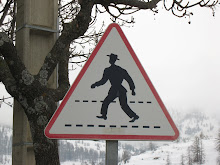
When I came back from the market, I came along our lane from above the house so as to avoid the construction. A curve or two before our driveway I found two signs placed in the roadway. The first expalined that the road was closed in 400 meters. The second sign was an arrow, and it read Deviation. The arrow pointed to the right, into a sharply sloping thicket of bamboo and blackberry briars. I could only surmise that my friend from the Champs-Elysees had been there.
Monday, December 17, 2007

Saturday, December 15, 2007
The Moulin du Rossignol
I decided belatedly to harvest our olives. Up and down our lane people had put nets under their olive trees at the end of September, and, a few weeks after that, we started seeing ladders in trees and olives raining down. M. LaChaix arrived at the end of October and was horrified that I had not harvested the olives; I actually felt like I had been wasteful and idle, instead of just unknowing, after his scolding. I told Olivier about it and he teased: "Didn't you know? In France it is always the responsibility of the renter to harvest the olives." So I was laughed out of my guilt and spent a couple of weeks just watching Wendy eat olives off the ground.
Wendy's interest in windfall olives amazed the entire equipe. It amazed us, too, once we figured out what was going on. Our neighbors who had spread nets under their olive trees were catching the ripe olives as they fell. Our ripe olives fell onto the ground, and Wendy, each time she was outside, scooped up a mouthful and brought them into the house. I started stepping on olive pits, and when we vacuumed the rug under the kitchen table, the sound of the olive pits being sucked up the hose was a little like the sound of popcorn popping.
Everyone had an opinion about Wendy and the olives. The gardener down the hill maintained that they would make her sick. Olivier's son, Thomas, thought the oil in the olives would make her coat shiny. Luigi and Olivier shook their heads and agreed that they had never seen a dog eat olives before. If you go back to America, Olivier said one day, we will have to send you olives for the dog.
While A. was visiting, we decided that it would be interesting to harvest a few of the trees. Just one or two, we thought, and then we would brine the olives and make our own tapenade. I asked Luigi about it. He shook his head. These olives, they are no good for eating. They are for oil. I will help you. Oil was not what I had imagined; how much oil could the olives from a few trees make? But the light in Luigi's eyes made me ask more questions. How would we harvest them? What about after harvest; what happened then? Luigi explained the whole process: nets under the trees, bamboo poles to shake the branches, ladders to climb up into the trees to pick the olives that didn't fall. Then pick the leaves and twigs out of the olives and spread them flat to cure for a few days before taking them to the mill. We had two mills to choose from, and Luigi recommended the smaller one. You drive by it every day on your way to school, he said. The Moulin de la Rossignol, the Mill of the Nightingale. If you take the olives there, you will get the oil from your own olives.
I signed on. An hour later Luigi appeared with nets and poles and a ladder and we began. The girls joined us after school, and my one or two trees quickly became the entire garden, 25 trees. Luigi volunteered to come and help on a Saturday, and, horrified at the thought of his taking a weekend to help me, I finished the last trees on Friday afternoon. When I called to let him know that we had finished, his wife called him to the phone: C'est madame l'Americaine. He sounded vaguely disappointed. Make sure you spread them out flat to cure; they'll spoil if you don't. And take out all the twigs, otherwise the mill won't accept them.
We spread the olives on dropcloths in the basement, and I spent evenings picking out the leaves and twigs. Luigi looked in to offer more tips a few times; Violette came to clean and put in her two cents. She had harvested 140 kilos of olives herself, and took them to a mill near Cabris. I asked where I should take mine, the Mill of the River or the Mill of the Nightingale? Violette put down the iron so she use both hands to make her point: The Mill of the River, ils sont voleurs. Those people are theives.
When I finished picking out the twigs, I put the olives into two crates and carried them upstairs, ready to take them to the Mill of the Nightingale. Violette looked in the crates. Non. Non. Ca ne marche pas. That won't do. The noyaus have to come out. You must take out all the pits; otherwise, the pits will block up the machinery, and then the mill will charge you for repairs. We knelt together on the kitchen floor and began picking out the pits. The girls joined us, and Violette announced that this was children's work; she went back to the ironing, and I, not wanting to look soft, began making dinner. When the girls had finished--after Violette had supervised them and checked their work for accuracy--she told them to carry the crates up the hill and put them in the car. Off we went to the mill of the Nightingale.
Not able to allow this process to be entirely old-fashioned, I had googled the Mill of the Nightingale. Its website was polished, with photos of olive trees artfully fading into photos of olives, and then of olive oil in lovely bottles on dark wooden tables. The mill had been built in 1760, and had produced olive oil for almost 200 years without pause; in 1956, there had been a killing freeze in the area, mortal for many olive trees, and the mill had closed its doors. The Giorgis family had reopened the mill in 1980, and restarted the tradition. The mill not only produced olive oil, but it had a shop where you could buy oil, tapenade, and other artisanal products. I was ready to be a customer.
We pulled up the the mill late on a Wednesday afternoon. There was a rusting dumpster in front of the building; weeds were growing around it. Pots of cyclamen and pansies, and a full clothesline, decorated a balcony above a small unloading dock. As I parked the car, a face appeared in the doorway off the loading dock, and a man came out.
Do you have an appointment? You cannot just come, you have to call. Did you call? You have to call. You cannot just bring olives. He came down the steps to my car. Open the trunk. Where are your olives? You must make an appointment next time. He scooped a handful of olives up and smelled them. These are fine. Bring them in. My back is bad, I cannot carry them.
The man looked like Mr. Bean, the British comedian, if Mr. Bean were a Provencal moulinier: he was compact, sturdy, with a mop of dark hair and intense black eyes. He hardly took a breath between sentences, and his accent was so strong that at times I wondered if he were speaking French or some other language entirely.
The inside of the mill was taller than it was wide. The ceiling was several meters away, but the floor was almost completely covered in immense green machinery, and what little floor space there was was taken up by baskets of olives. The air smelled of olive oil; it even felt a little thick, a little oily. When you breathed in, the air tasted green and sharp. The mill's website said, Olive oil is a noble product which should be savoured, and which accompanies with happiness provencale cusisine. The olive tree being a humble tree, its products should be used in simple recipes.
The moulinier dumped our olives into wire baskets and weighed them. 27 kilos. Did you bring a bidon? You don't have a bidon? Not only did I not have a bidon, I didn't know what a bidon was; all I could be sure of was that I understood that he was asking me if I had something, and all I had was a car, a pocketbook, two children, and two bins of olives. None of those sounded anything like a bidon. He shook his head in resignation. No appointment, no phone call, and now, no bidon. All right. This is what you are going to do. You know the Agricultural cooperative? By some minor miracle I did. All right. You are going to go there, right now, and you are going to ask to speak to M. Girard. Who are you going to ask to speak to?
M. Girard, I said.
Right. And you are going to tell M. Girard that M. Giorgis from the Moulin du Rossignol sent you, and you need a bidon. A plastic bidon, five liters. What are you going to ask for?
A bidon of five liters?
Right. And then you are going to bring that back here, right now, and leave it on the steps outside, because I have to go out. Where are you going to leave it?
On the steps outside?
Right. Okay. I will call you when the olives are ready. Now what is your phone number?
I looked at him blankly. I had not understood his last words at all. He held his hand up to his ear, thumb and little finger extended to look like a telephone. I gave him my cell phone number.
I will call you. Do not call me. Leave the bidon outside. Who are you going to see at the cooperative?
Yes, okay, M. Girard. I went out the door and down the steps.
At the cooperative, M. Girard left his post behind the desk and walked past the aisles of rope, birdseed, canning jars, rubber boots, and wooden clogs. He came back with a plastic jug, the same sort of jug that C. keeps extra gas in for the lawn mower. I paid my three euros and went back to the mill. One of the girls hopped out of the car and left the jug on the steps; M. Giorgis senior, sporting an enormous waxed moustache, came out and stood on the balcony and watched as we turned the car around in the driveway and left. At the corner, Christmas lights were strung across the street, white bulbs interspersed with a yellow star, red bell, and a few green leaves. They blinked a little as we drove under them and turned towards home.
A few days later, Olivier came back from a trip, and I told him about my olive mill adventure. We were standing outside M. LaChaix's house, up at the top of the hill, and looking out across the valley towards Grasse and the sea. I know the family whose mill it is. P. H. Giorgis, Olivier said. Father and son.
I think we saw the son. Do you know the British comedian, Mr. Bean? Olivier nodded. The son looks like Mr. Bean would look if he had an olive mill in Grasse.
Olivier smiled. And the father, did he have a moustache?
Yes, a big one.
It's the last olive mill in Grasse. There used to be mills all through this valley, but that one, the Moulin du Rossignol, that's the last one.
I saw M. Giorgis fils at the market the next day, and asked him about my olives. His expression was blank. Remember, I prompted him, I didn't have an appointment?
Oh yes. Recognition dawned. Your oil is ready. You can come and get them this afternoon, after 5:30.
L. was visiting, and we went together to the mill. Mr. Bean was there and we had another impenetrable one-sided conversation as I paid him 13 euros for the nearly 5 liters of extra virgin olive oil that my olives had produced. As we left, M. Giorgis pere and his moustache came in. Let the oil settle for a few days before you bottle it, he said. But you can go ahead and taste some tonight, with a little salad. He smiled. His son asked how long we had been in France. Six months, I said. This is the first time we've ever harvested olives. The Giorgis, father and son, nodded and smiled as they shook our hands. Bonne continuation, they said. A la prochaine. We'll see you next time.
Violette says she'll help me filter the oil and bottle it, and I'm still looking for the right sort of bottles. But we did taste the oil that night on bit of baguette. It tasted green, and a little spicy, and strong, like eating it would make you live a longer and, chances are, a happier life.
Wendy's interest in windfall olives amazed the entire equipe. It amazed us, too, once we figured out what was going on. Our neighbors who had spread nets under their olive trees were catching the ripe olives as they fell. Our ripe olives fell onto the ground, and Wendy, each time she was outside, scooped up a mouthful and brought them into the house. I started stepping on olive pits, and when we vacuumed the rug under the kitchen table, the sound of the olive pits being sucked up the hose was a little like the sound of popcorn popping.
Everyone had an opinion about Wendy and the olives. The gardener down the hill maintained that they would make her sick. Olivier's son, Thomas, thought the oil in the olives would make her coat shiny. Luigi and Olivier shook their heads and agreed that they had never seen a dog eat olives before. If you go back to America, Olivier said one day, we will have to send you olives for the dog.
While A. was visiting, we decided that it would be interesting to harvest a few of the trees. Just one or two, we thought, and then we would brine the olives and make our own tapenade. I asked Luigi about it. He shook his head. These olives, they are no good for eating. They are for oil. I will help you. Oil was not what I had imagined; how much oil could the olives from a few trees make? But the light in Luigi's eyes made me ask more questions. How would we harvest them? What about after harvest; what happened then? Luigi explained the whole process: nets under the trees, bamboo poles to shake the branches, ladders to climb up into the trees to pick the olives that didn't fall. Then pick the leaves and twigs out of the olives and spread them flat to cure for a few days before taking them to the mill. We had two mills to choose from, and Luigi recommended the smaller one. You drive by it every day on your way to school, he said. The Moulin de la Rossignol, the Mill of the Nightingale. If you take the olives there, you will get the oil from your own olives.
I signed on. An hour later Luigi appeared with nets and poles and a ladder and we began. The girls joined us after school, and my one or two trees quickly became the entire garden, 25 trees. Luigi volunteered to come and help on a Saturday, and, horrified at the thought of his taking a weekend to help me, I finished the last trees on Friday afternoon. When I called to let him know that we had finished, his wife called him to the phone: C'est madame l'Americaine. He sounded vaguely disappointed. Make sure you spread them out flat to cure; they'll spoil if you don't. And take out all the twigs, otherwise the mill won't accept them.
We spread the olives on dropcloths in the basement, and I spent evenings picking out the leaves and twigs. Luigi looked in to offer more tips a few times; Violette came to clean and put in her two cents. She had harvested 140 kilos of olives herself, and took them to a mill near Cabris. I asked where I should take mine, the Mill of the River or the Mill of the Nightingale? Violette put down the iron so she use both hands to make her point: The Mill of the River, ils sont voleurs. Those people are theives.
When I finished picking out the twigs, I put the olives into two crates and carried them upstairs, ready to take them to the Mill of the Nightingale. Violette looked in the crates. Non. Non. Ca ne marche pas. That won't do. The noyaus have to come out. You must take out all the pits; otherwise, the pits will block up the machinery, and then the mill will charge you for repairs. We knelt together on the kitchen floor and began picking out the pits. The girls joined us, and Violette announced that this was children's work; she went back to the ironing, and I, not wanting to look soft, began making dinner. When the girls had finished--after Violette had supervised them and checked their work for accuracy--she told them to carry the crates up the hill and put them in the car. Off we went to the mill of the Nightingale.
Not able to allow this process to be entirely old-fashioned, I had googled the Mill of the Nightingale. Its website was polished, with photos of olive trees artfully fading into photos of olives, and then of olive oil in lovely bottles on dark wooden tables. The mill had been built in 1760, and had produced olive oil for almost 200 years without pause; in 1956, there had been a killing freeze in the area, mortal for many olive trees, and the mill had closed its doors. The Giorgis family had reopened the mill in 1980, and restarted the tradition. The mill not only produced olive oil, but it had a shop where you could buy oil, tapenade, and other artisanal products. I was ready to be a customer.
We pulled up the the mill late on a Wednesday afternoon. There was a rusting dumpster in front of the building; weeds were growing around it. Pots of cyclamen and pansies, and a full clothesline, decorated a balcony above a small unloading dock. As I parked the car, a face appeared in the doorway off the loading dock, and a man came out.
Do you have an appointment? You cannot just come, you have to call. Did you call? You have to call. You cannot just bring olives. He came down the steps to my car. Open the trunk. Where are your olives? You must make an appointment next time. He scooped a handful of olives up and smelled them. These are fine. Bring them in. My back is bad, I cannot carry them.
The man looked like Mr. Bean, the British comedian, if Mr. Bean were a Provencal moulinier: he was compact, sturdy, with a mop of dark hair and intense black eyes. He hardly took a breath between sentences, and his accent was so strong that at times I wondered if he were speaking French or some other language entirely.
The inside of the mill was taller than it was wide. The ceiling was several meters away, but the floor was almost completely covered in immense green machinery, and what little floor space there was was taken up by baskets of olives. The air smelled of olive oil; it even felt a little thick, a little oily. When you breathed in, the air tasted green and sharp. The mill's website said, Olive oil is a noble product which should be savoured, and which accompanies with happiness provencale cusisine. The olive tree being a humble tree, its products should be used in simple recipes.
The moulinier dumped our olives into wire baskets and weighed them. 27 kilos. Did you bring a bidon? You don't have a bidon? Not only did I not have a bidon, I didn't know what a bidon was; all I could be sure of was that I understood that he was asking me if I had something, and all I had was a car, a pocketbook, two children, and two bins of olives. None of those sounded anything like a bidon. He shook his head in resignation. No appointment, no phone call, and now, no bidon. All right. This is what you are going to do. You know the Agricultural cooperative? By some minor miracle I did. All right. You are going to go there, right now, and you are going to ask to speak to M. Girard. Who are you going to ask to speak to?
M. Girard, I said.
Right. And you are going to tell M. Girard that M. Giorgis from the Moulin du Rossignol sent you, and you need a bidon. A plastic bidon, five liters. What are you going to ask for?
A bidon of five liters?
Right. And then you are going to bring that back here, right now, and leave it on the steps outside, because I have to go out. Where are you going to leave it?
On the steps outside?
Right. Okay. I will call you when the olives are ready. Now what is your phone number?
I looked at him blankly. I had not understood his last words at all. He held his hand up to his ear, thumb and little finger extended to look like a telephone. I gave him my cell phone number.
I will call you. Do not call me. Leave the bidon outside. Who are you going to see at the cooperative?
Yes, okay, M. Girard. I went out the door and down the steps.
At the cooperative, M. Girard left his post behind the desk and walked past the aisles of rope, birdseed, canning jars, rubber boots, and wooden clogs. He came back with a plastic jug, the same sort of jug that C. keeps extra gas in for the lawn mower. I paid my three euros and went back to the mill. One of the girls hopped out of the car and left the jug on the steps; M. Giorgis senior, sporting an enormous waxed moustache, came out and stood on the balcony and watched as we turned the car around in the driveway and left. At the corner, Christmas lights were strung across the street, white bulbs interspersed with a yellow star, red bell, and a few green leaves. They blinked a little as we drove under them and turned towards home.
A few days later, Olivier came back from a trip, and I told him about my olive mill adventure. We were standing outside M. LaChaix's house, up at the top of the hill, and looking out across the valley towards Grasse and the sea. I know the family whose mill it is. P. H. Giorgis, Olivier said. Father and son.
I think we saw the son. Do you know the British comedian, Mr. Bean? Olivier nodded. The son looks like Mr. Bean would look if he had an olive mill in Grasse.
Olivier smiled. And the father, did he have a moustache?
Yes, a big one.
It's the last olive mill in Grasse. There used to be mills all through this valley, but that one, the Moulin du Rossignol, that's the last one.
I saw M. Giorgis fils at the market the next day, and asked him about my olives. His expression was blank. Remember, I prompted him, I didn't have an appointment?
Oh yes. Recognition dawned. Your oil is ready. You can come and get them this afternoon, after 5:30.
L. was visiting, and we went together to the mill. Mr. Bean was there and we had another impenetrable one-sided conversation as I paid him 13 euros for the nearly 5 liters of extra virgin olive oil that my olives had produced. As we left, M. Giorgis pere and his moustache came in. Let the oil settle for a few days before you bottle it, he said. But you can go ahead and taste some tonight, with a little salad. He smiled. His son asked how long we had been in France. Six months, I said. This is the first time we've ever harvested olives. The Giorgis, father and son, nodded and smiled as they shook our hands. Bonne continuation, they said. A la prochaine. We'll see you next time.
Violette says she'll help me filter the oil and bottle it, and I'm still looking for the right sort of bottles. But we did taste the oil that night on bit of baguette. It tasted green, and a little spicy, and strong, like eating it would make you live a longer and, chances are, a happier life.
Friday, December 7, 2007
Une belle dinde
The holidays, all of them, have snuck up on me this year. I expected the fall to last longer, somehow, but it didn't, and a few weeks ago C. started talking about whom to invite for Thanksgiving, and now that's past and we are rollicking on towards Christmas, not to mention Hanukkah, of which we are now in the midst and which I very nearly forgot altogether.
But back to Thanksgiving. A. was still here when C. began working on the guest list, and in her helpful way she asked where we would get a turkey. I realized that I had no idea, aucune idee, where to find a turkey. I had never seen one in the poultry section of any of the grocery stores where I shop. I don't go into butcher shops very often, but I realized, after thinking for a moment or two, that I could not remember seeing a turkey in any of them. No turkeys were ever advertised as being on special; the most evidence of turkey that I had ever seen was the occasional package of escalope de dinde in the poultry section. An almost endless variety of chickens, large, small and medium, male and female: but never a turkey.
Yet it was our intention to have a full American Thanksgiving. L. and G. were coming from Paris, and bringing us cranberry sauce, canned pumpkin puree, and (not without some guilt and ambivalence on my part, but to E. and G.'s complete delight) a bag of marshmallows to put on the sweet potato pudding. And so I would have to find a turkey.
On a cold morning two weeks before Thanksgiving I ventured in to our local butcher shop. I had bought a roasted chicken or two there before--most recently, I had bought a roasted chicken in the evening that had been roasted in the morning, and my willingness to do so baffled the butcher, who seemed to take it both as a personal favor to him (buying chicken that was not moments off of the rotisserie!) and to find it deeply puzzling (why would Madame buy a chicken left over from this morning's roasting?)--but I was far from being a regular, a cliente. The shop was empty when I went in. Chickens were roasting, quiches and tartes were arranged on the top of the meat case, and the case itself was full of an elaborate and bloody assortment of cuts of beef, lamb, veal, rabbit arrayed in carnivorous glory.
I asked for some chicken breasts and, while the butcher was wrapping them, I ventured my request. I would like to order a turkey, if that's possible.
Ah. Vous faites le Thanksgiving americain. You are making American Thanksgiving. The butcher smiled and wiped his hands on his apron.
I smiled back, encouraged. Can you get turkeys for Thanksgiving?
But of course. A woman in Valbonne ordered one the other day. It is what you always eat for Thanksgiving, no? Turkey farcis? Stuffed turkey?
Yes, yes. We will be 12 people; can you get me a turkey the right size for that many people?
We conferred a bit about what the right size was, and when I should pick it up, and he took my name and phone number. I had one last request.
When you prepare the turkey, Monsieur, can you make it very clean? The roast chicken I had bought recently had come with shins attached. Did you know that chickens have shins? They do. In a rare moment of courage, I had snapped the roasted shins off of the legs before I carved the bird and before anyone else in the household could see them and decide to commence vegetarianism that night. However, I did not trust myself to be able to come to terms with turkey shins, or feet, or any other parts of the turkey never reproduced as a Normal Rockwell illustration of Thanksgiving.
The butcher looked quizzically at me. I tried to explain: no gizzards, no organs, no shins, but my French failed me. I fell back on foreignness. Could you, Monsieur, prepare the turkey as though it was for an American lady?
Now he nodded. Do not worry, Madame. It will be all clean.
The day before we were to make our Thanksgiving americain, L. and I went to pick up the turkey. The shop was busy; two butchers were on duty, the one from whom I had bought the chicken with shins and the one who had taken my turkey order. The turkey order man was attending to three ladies of a certain age. The ladies were turned out in sunglasses, leopard prints, sleek black suits, heels, and gloves; they looked like they had just been transported from one of the more fashionable shopping streets on the Right Bank. They were ordering an assortment of items for lunch.
But back to Thanksgiving. A. was still here when C. began working on the guest list, and in her helpful way she asked where we would get a turkey. I realized that I had no idea, aucune idee, where to find a turkey. I had never seen one in the poultry section of any of the grocery stores where I shop. I don't go into butcher shops very often, but I realized, after thinking for a moment or two, that I could not remember seeing a turkey in any of them. No turkeys were ever advertised as being on special; the most evidence of turkey that I had ever seen was the occasional package of escalope de dinde in the poultry section. An almost endless variety of chickens, large, small and medium, male and female: but never a turkey.
Yet it was our intention to have a full American Thanksgiving. L. and G. were coming from Paris, and bringing us cranberry sauce, canned pumpkin puree, and (not without some guilt and ambivalence on my part, but to E. and G.'s complete delight) a bag of marshmallows to put on the sweet potato pudding. And so I would have to find a turkey.
On a cold morning two weeks before Thanksgiving I ventured in to our local butcher shop. I had bought a roasted chicken or two there before--most recently, I had bought a roasted chicken in the evening that had been roasted in the morning, and my willingness to do so baffled the butcher, who seemed to take it both as a personal favor to him (buying chicken that was not moments off of the rotisserie!) and to find it deeply puzzling (why would Madame buy a chicken left over from this morning's roasting?)--but I was far from being a regular, a cliente. The shop was empty when I went in. Chickens were roasting, quiches and tartes were arranged on the top of the meat case, and the case itself was full of an elaborate and bloody assortment of cuts of beef, lamb, veal, rabbit arrayed in carnivorous glory.
I asked for some chicken breasts and, while the butcher was wrapping them, I ventured my request. I would like to order a turkey, if that's possible.
Ah. Vous faites le Thanksgiving americain. You are making American Thanksgiving. The butcher smiled and wiped his hands on his apron.
I smiled back, encouraged. Can you get turkeys for Thanksgiving?
But of course. A woman in Valbonne ordered one the other day. It is what you always eat for Thanksgiving, no? Turkey farcis? Stuffed turkey?
Yes, yes. We will be 12 people; can you get me a turkey the right size for that many people?
We conferred a bit about what the right size was, and when I should pick it up, and he took my name and phone number. I had one last request.
When you prepare the turkey, Monsieur, can you make it very clean? The roast chicken I had bought recently had come with shins attached. Did you know that chickens have shins? They do. In a rare moment of courage, I had snapped the roasted shins off of the legs before I carved the bird and before anyone else in the household could see them and decide to commence vegetarianism that night. However, I did not trust myself to be able to come to terms with turkey shins, or feet, or any other parts of the turkey never reproduced as a Normal Rockwell illustration of Thanksgiving.
The butcher looked quizzically at me. I tried to explain: no gizzards, no organs, no shins, but my French failed me. I fell back on foreignness. Could you, Monsieur, prepare the turkey as though it was for an American lady?
Now he nodded. Do not worry, Madame. It will be all clean.
The day before we were to make our Thanksgiving americain, L. and I went to pick up the turkey. The shop was busy; two butchers were on duty, the one from whom I had bought the chicken with shins and the one who had taken my turkey order. The turkey order man was attending to three ladies of a certain age. The ladies were turned out in sunglasses, leopard prints, sleek black suits, heels, and gloves; they looked like they had just been transported from one of the more fashionable shopping streets on the Right Bank. They were ordering an assortment of items for lunch.
Meanwhile, the chicken shins butcher turned to us. I explained that I had ordered a turkey. Ah! Une belle dinde! He smiled, glad that this time I was not settling for a leftover chicken. A pretty turkey! He rubbed his hands together and went behind the counter, where he opened a large door. I had seen that door, of course, but had never wondered what was behind it, in the same way, I imagine, that we Americans can look at a piece of meat on white styrofoam wrapped in plastic and not wonder where it came from. Well, wonder no more. The door opened to reveal a walk-in meat locker easily half the size again of the shop itself. Entire sides of beef hung from hooks in the ceiling. L. and I both drew back a half step.
Three turkeys hung from hooks across from the sides of beef. Our butcher took the first one and brought it out into the shop to weigh it. It was a little feathery and--how does one say this?--obviously quite fresh. Perhaps the best way to describe it is to describe something else in its place: a turkey from an American supermarket, for instance. What I have always unwrapped, or asked someone else to unwrap for me, on the kitchen counter on Thanksgiving morning, has been a white, white bird. If there were organs, they were neatly wrapped in waxed paper in the cavity of the bird. No feathers. No suggestion that this creature walked around recently, and no suggestion, either, of what it might have walked around on. The turkey that the butcher happily began to wrap up for us looked like it had probably enjoyed a hearty supper the night before.
That's not her turkey; someone's already bought that turkey, the other butcher interrupted him. Go get one of the other turkeys for her.
Our butcher shrugged and went back in the meat locker. Meanwhile, the leopard ladies were still ordering. We'll take some slices of roast beef; it's rare, isn't it?
Their butcher took a slab of roast beef the size of his forearm out of the case. With an immense knife, he shaved off a few deep pink slices.
And some of these beignets, these little doughnuts. They're so good with coffee. The taller leopard lady turned to the shorter one and they bobbed their heads at each other confidentially.
Their butcher wrapped the roast beef in paper and reached up to the top of the counter for a handful of beignets. There was no intermediate step: wrap the bloody beef, pick up the beignets.
Our butcher emerged from the meat locker with a second turkey. This one was a few grams smaller and had fewer feathers. The leopard ladies went off with their bloody roast beef and beignets, and our butcher wrapped and bagged the turkey--5 kilos and change--and handed over the bill with a flourish: Ca fait 79 euros, s'il vous plait, Madame.
In years past I have hesitated, as I stood at the turkey desk in Whole Foods, over whether to order the organic, free-range, baptised turkey at $3.47 per pound or to order instead the slightly less well-cared for bird at $2.50 per pound. Those days are gone. Thirty, forty dollars for a turkey? I will scoff at Thanksgiving tables in the future. Why, I remember the year I paid over a hundred dollars for a turkey in France.
It was a good turkey, though. It tasted different from the Butterballs of my childhood, and from the organic Toms of the past few years, a stronger taste, a turkier taste. We were pretty sure, L. and C. and I, that this turkey had not been injected with anything, and we could see for ourselves that there had been no chemical solvents, unless you count water, involved in preparing it for sale. And, though I'm sure the butchers and the turkey farmer are not going hungry, I don't think there was a whole lot of profit injected into the price. There are fewer people wanting turkeys, and fewer turkeys to be had, so turkeys cost more. (A lot more.)
The distance between production and consumption is shorter, and is not shrink-wrapped. Feathers and blood are a part of life and death, and eating beignets that have been close to roast beef juices probably won't kill you or even make you sick. (At least if you don't think about it too much.)
Nevertheless, I think we'll give turkey a miss for Christmas. Lobster might be cheaper.
In the rue Servandoni
Last week I was back in Paris with L. and G. We went to lunch, L. and I, at a creperie in the rue Servandoni. The creperie--and as far as I can tell, that is its only name--is the size of a smallish American living room, with tables and benches at the front, near the plate glass window and the door, and an open kitchen at the back, with the crepe-making griddle jutting out into the center of the narrow room. Madame, a sturdy woman in late middle age who looks like she would be equally comfortable standing in front of a grill at an American lunch counter, stands behind the griddle, spatula at the ready. Her ancient Jack Russell terrier either sleeps in his basket in the corner or patrols the tables looking for scraps. There are two steps up from the street into the dining room, but, due to a trick of the pavement, three steps down, and either Madame or the young woman waiting tables will remind you when you leave to watch out for the third step.
E., G., and I found this creperie on Easter day in 2005, and I keep going back to it every chance I get. After I stopped weeping daily about the outcome of the 2004 elections, I thought about what kind of excursion would make me really happy. And I thought of Paris. It had been nine years at that point since I had been in France; we had always talked about bringing the girls to France when they were of travelling age. It was time. We made airplane reservations and found an apartment to rent that was near where I had lived as a student and around the corner from the Eglise de Saint-Sulpice and its beautiful place. Thus we came to spend Easter vacation 2005 in the rue Servandoni.
We arrived at the apartment in the rue Servandoni on Easter weekend. The street is a block long, and connects Saint-Sulpice to the Luxembourg Gardens. That much I knew from my dog-earred Michelin Plan de Paris. But the instructive plaques on the street--you cannot walk more than a few feet in central Paris without coming across a plaque on a building, telling you about a historical character who was born or lived or died there--told a longer story. If you sit at the table in the window of the creperie, as L. and I did last week, and as we did last March, and as I did a year before that, and, again, with G. and E. on Easter day 2005, then when you look out the window and across the street you see a plaque that tells you that William Faulkner lived in that building for several months in 1925. If you are a southerner and a reader then, voila, you are connected: from Yoknapatawpha County to the City of Lights before you even order lunch.
Finish your crepe--I recommend the crepe parmentier, potatoes and cheese and an egg folded inside a warm crepe au sarrasin--and, minding the third step, walk out of the creperie and to the right, up towards Saint-Sulpice. Another plaque appears. William Faulkner's neighbor, two doors up and a century and change earlier, was the revolutionary Olympe de Gouges. De Gouges took her revolutionary brothers' bet and raised them, publishing in 1790 her proto-feminist Declaration of the Rights of Women to match the 1789 Declaration of the Rights of Man. Looked on as a novelty for a while, she eventually wore out her welcome and went to the guillotine, but not before she lived in the rue Servandoni for a while. She survives now in history books and dissertations--one of them mine. When I wrote about women in the French Revolution, her papers came across my desk in the Archives nationales across the Seine in the rue Rambuteau.
A little further up the street, and this time I saw a plaque I had missed before: Condorcet, one of the gentlest philosophers and scientists of the Enlightenment, and also one of the most unfortunate, had hidden in an apartment in that building for several months during the Revolution, after he had fallen from the good graces of the National Convention. My dissertation advisor--not a particularly nice or gentle man, but a good historian--wrote his first major book on Condorcet, and it sat on my shelves (reddish-orange binding, black letters) for years.
L. and I walked past these plaques and all their connections last weekend, and just as we passed the building where I stayed with my family nearly three years ago, my cell phone rang. It was C.: where was the cinnamon? L. and I had finished it off making pumpkin pie for our Provencal Thanksgiving. As we spoke on the phone L. and I turned the corner into the place Saint-Sulpice, where the booths for the Christmas market were already set up.
On my best days I feel part of a web of connections--connections of love and of the mind and of the past, my own and the world's--and it is so startling to me, so surprising, to find that web so dense on this little street in the Left Bank. The other day I found this, from Emily Dickinson, in my reading: To live is so startling it leaves little time for anything else. I am very busy.
E., G., and I found this creperie on Easter day in 2005, and I keep going back to it every chance I get. After I stopped weeping daily about the outcome of the 2004 elections, I thought about what kind of excursion would make me really happy. And I thought of Paris. It had been nine years at that point since I had been in France; we had always talked about bringing the girls to France when they were of travelling age. It was time. We made airplane reservations and found an apartment to rent that was near where I had lived as a student and around the corner from the Eglise de Saint-Sulpice and its beautiful place. Thus we came to spend Easter vacation 2005 in the rue Servandoni.
We arrived at the apartment in the rue Servandoni on Easter weekend. The street is a block long, and connects Saint-Sulpice to the Luxembourg Gardens. That much I knew from my dog-earred Michelin Plan de Paris. But the instructive plaques on the street--you cannot walk more than a few feet in central Paris without coming across a plaque on a building, telling you about a historical character who was born or lived or died there--told a longer story. If you sit at the table in the window of the creperie, as L. and I did last week, and as we did last March, and as I did a year before that, and, again, with G. and E. on Easter day 2005, then when you look out the window and across the street you see a plaque that tells you that William Faulkner lived in that building for several months in 1925. If you are a southerner and a reader then, voila, you are connected: from Yoknapatawpha County to the City of Lights before you even order lunch.
Finish your crepe--I recommend the crepe parmentier, potatoes and cheese and an egg folded inside a warm crepe au sarrasin--and, minding the third step, walk out of the creperie and to the right, up towards Saint-Sulpice. Another plaque appears. William Faulkner's neighbor, two doors up and a century and change earlier, was the revolutionary Olympe de Gouges. De Gouges took her revolutionary brothers' bet and raised them, publishing in 1790 her proto-feminist Declaration of the Rights of Women to match the 1789 Declaration of the Rights of Man. Looked on as a novelty for a while, she eventually wore out her welcome and went to the guillotine, but not before she lived in the rue Servandoni for a while. She survives now in history books and dissertations--one of them mine. When I wrote about women in the French Revolution, her papers came across my desk in the Archives nationales across the Seine in the rue Rambuteau.
A little further up the street, and this time I saw a plaque I had missed before: Condorcet, one of the gentlest philosophers and scientists of the Enlightenment, and also one of the most unfortunate, had hidden in an apartment in that building for several months during the Revolution, after he had fallen from the good graces of the National Convention. My dissertation advisor--not a particularly nice or gentle man, but a good historian--wrote his first major book on Condorcet, and it sat on my shelves (reddish-orange binding, black letters) for years.
L. and I walked past these plaques and all their connections last weekend, and just as we passed the building where I stayed with my family nearly three years ago, my cell phone rang. It was C.: where was the cinnamon? L. and I had finished it off making pumpkin pie for our Provencal Thanksgiving. As we spoke on the phone L. and I turned the corner into the place Saint-Sulpice, where the booths for the Christmas market were already set up.
On my best days I feel part of a web of connections--connections of love and of the mind and of the past, my own and the world's--and it is so startling to me, so surprising, to find that web so dense on this little street in the Left Bank. The other day I found this, from Emily Dickinson, in my reading: To live is so startling it leaves little time for anything else. I am very busy.
Thursday, November 22, 2007
Une action de grace
The New York Times today includes an article on the psychological benefits of gratitude. Turns out that being grateful and saying thank you, even making lists of things for which you are grateful, can actually make you a happier person--and not just on Thanksgiving Day, which is what today is, but all the time. I would describe myself as generally happy with a chance of late afternoon irritation, but in the spirit of the our first Thanksgiving in France, here is my list.
Thanksgiving is not a noun in French but a phrase: it is une action de grace, literally, an action of grace. So here are some actions of grace for which I am particularly grateful this Thanksgiving day:
Alice and Wendy, curled up at my feet in my warm kitchen, while chicken stock simmers on the stove and rain falls outside. They keep thinking they want to go outside, but when I open the door and they see the rain, they look up at me in horror and go back to the rug.
M. LaChaix, who just phoned me from a traffic jam in Paris to say that I should absolutely feel free, not hesitate one half minute, to use the refrigerator in his house up the hill to store our Thanksgiving overflow. He does go on, but inside the bossy Parisien exterior there lurks a kind heart.
Olivier, who, last night before he went home, gave me two large bottles of eau de cologne, made at the parfumerie where his wife works. One bottle of lavender water, the other of a lemony, light scent, and when I thanked him he said, Non, non, c'est normale.
C., who took me to the hospital last weekend for stitches in my hand after I dropped a tea cup, who found his way to the hospital on the far side of Grasse in the dark and with a bleeding and woozy wife in the front seat beside him. Who figured out where to park the car--which was not evident, pas du tout--and made me laugh. Who stood beside me holding my hand for the whole event; who, even though the sight of blood makes him faint, never paled.
E. and G., who have held my hand every night this week while C. changed my bandage, even though there hands are so small in mine that I am afraid I will hurt them if I squeeze too tightly.
A. and L. and Paris. Oscar Wilde said that when good Americans die they go to Paris; I have not been particularly good, but nevertheless the universe afforded me sufficient grace not just to go to Paris again, but to go with my two best girlfriends. We walked down the Avenue Victor Hugo at dusk, and as we looked at the beautiful cakes in the windows at Le Notre, the trumpeter in a strolling Dixieland band rolled out the first few notes of "Hello, Dolly." His confreres joined in as we gazed in at the pink and green macaroons stacked up into a baroque festival of a patisserie, and then the band followed us as we strolled down the street towards home, where there were people we loved waiting for us, and good food and light and warmth.
Pas mal, as the French say. Pas mal du tout. Thanks.
Thanksgiving is not a noun in French but a phrase: it is une action de grace, literally, an action of grace. So here are some actions of grace for which I am particularly grateful this Thanksgiving day:
Alice and Wendy, curled up at my feet in my warm kitchen, while chicken stock simmers on the stove and rain falls outside. They keep thinking they want to go outside, but when I open the door and they see the rain, they look up at me in horror and go back to the rug.
M. LaChaix, who just phoned me from a traffic jam in Paris to say that I should absolutely feel free, not hesitate one half minute, to use the refrigerator in his house up the hill to store our Thanksgiving overflow. He does go on, but inside the bossy Parisien exterior there lurks a kind heart.
Olivier, who, last night before he went home, gave me two large bottles of eau de cologne, made at the parfumerie where his wife works. One bottle of lavender water, the other of a lemony, light scent, and when I thanked him he said, Non, non, c'est normale.
C., who took me to the hospital last weekend for stitches in my hand after I dropped a tea cup, who found his way to the hospital on the far side of Grasse in the dark and with a bleeding and woozy wife in the front seat beside him. Who figured out where to park the car--which was not evident, pas du tout--and made me laugh. Who stood beside me holding my hand for the whole event; who, even though the sight of blood makes him faint, never paled.
E. and G., who have held my hand every night this week while C. changed my bandage, even though there hands are so small in mine that I am afraid I will hurt them if I squeeze too tightly.
A. and L. and Paris. Oscar Wilde said that when good Americans die they go to Paris; I have not been particularly good, but nevertheless the universe afforded me sufficient grace not just to go to Paris again, but to go with my two best girlfriends. We walked down the Avenue Victor Hugo at dusk, and as we looked at the beautiful cakes in the windows at Le Notre, the trumpeter in a strolling Dixieland band rolled out the first few notes of "Hello, Dolly." His confreres joined in as we gazed in at the pink and green macaroons stacked up into a baroque festival of a patisserie, and then the band followed us as we strolled down the street towards home, where there were people we loved waiting for us, and good food and light and warmth.
Pas mal, as the French say. Pas mal du tout. Thanks.
Wednesday, November 21, 2007
Menusier
La Bastiole is a new house, and when we moved into it a few months ago, there were still odds and ends remaining to finish. Our landlord, M. LaChaix, assured us that all would be completed quickly and efficiently, and work continued after we moved in, albeit at a decidedly summer-in-Provence pace. At the end of the summer, as our landlord was closing up his house and preparing to drive back to Paris, he told me not to worry. Instead of having Olivier finish all the work inside the house, the landlord's own favorite carpenter, M. Duc, would be coming. From Paris. For a week, in October, to finish all the odds and ends.
The local equipe greeted this news with much rolling of eyes and shaking of heads. He has to have a carpenter from Paris, you know, because of course we don't have any carpenters around here, said the gardener at the villa below us. From Paris? Un menusier Parisian? Violette stopped just short of spitting. C'est typique. Luigi, the Italian man who comes to help Olivier sometimes, sighed and shrugged. Parisians like Parisians, he said, in his Italian-accented French. And Olivier shook his head. C'est ca, c'est M. LaChaix. The work that M. Duc from Paris was to do for us was not complicated or involved or even particularly skilled--there was some sanding to be done here and there, a couple of missing screws to put in, a trap door to fit. Nothing that could not have been done by Olivier, or Luigi, or any of their friends and colleagues in the village. But, the Parisian menuisier it was to be.
Before he took the autoroute for Paris, M. LaChaix came down the hill for a final look over the house. He took me and Olivier down to the basement and pointed to a heap of old kitchen cabinetry in the corner. This, he showed us, this was going to become shelving for my laundry room. He directed Olivier to help him sort the cabinets out, talking the whole dusty time about how the cabinets could be placed, arranged against the wall, to help me put--and here he glanced pointedly at the detritus of our moving--everything in order. M. Duc would do it; he would understand exactly how it was all to be done. The cabinets were old, but they still had a lot of use left in them.
Olivier leaned over to me, unnoticed by M. LaChaix, who was in full voice on the subject of arranging the cabinets, and said in perfect English, These are good for firewood.
Eventually, after a lot of phone calls from M. LaChaix in Paris, the day came when the menusier was to arrive. The night before, I had a long conversation on the phone with our landlord, and we made a list together of what M. Duc's priorities would be. He was driving down from Paris with his apprentice, and would be at our house the next morning at 8:00.
And he was. M. Duc is approaching 50, with thick grey hair and an impressive moustache, and the beginnings of a serious paunch. When he came into our kitchen, his pants were held up by a length of cord looped through the beltloops. The apprentice, Mathieu, was skinny in the way that only 20-year-olds with a heavy dose of attitude and multiple body piercings can be.
I took out my list and began to go over it with M. Duc. He nodded, puzzled, and I continued, using my best French, trying to make myself understood. But no, language was not the problem. After I continued for a few minutes, M. Duc stopped me. "C'est M. LaChaix qui me dirige, Madame. It is M. LaChaix who is telling me what to do, Madame."
I retreated behind southern graciousness and left him to his business. Later on in the day, I saw Luigi and Olivier outside, working on the mysterious septic pipes. We compared notes on the Parisien arrivals, and I allowed as how I had been put in my place. There was some shrugging and rolling of eyes--no accounting for foreign manners, and for once I was not the foreigner under discussion--and we went on to talk of other things. When the locals turned and knelt back down on the terrace to put their heads in the septic pipes, I thanked them for working on the septic. It's not a pleasant job, and they were at it day after day, resigned but cheerful. Olivier popped his head back up. He grinned. "C'est M. LaChaix qui nous dirige. It's M. LaChaix who tells us what to do."
The week progressed slowly, as M. Duc and Mathieu unloaded an entire carpentry workshop from the hatchback of their Peugeot and set it up on our back terrace. The temperature hit 65, and Mathieu took his shirt off, affording all of us the opportunity to wonder how exactly one decides to have the back of one's neck pierced, and the opportunity to hope that Mathieu's hips, skinny as they were, would be sufficient to hold up his low-slung, baggy blue jeans. The knot in the cord holding up M. Duc's pants held, and, after a few days, he even managed to be somewhat friendly to me, in a distant, cool sort of way. I suppose that if you pay a carpenter from Paris to install second- or third-hand cabinetry in Provence for a week, some hauteur comes with the territory. I coped with the attitude and the hauteur and the sawdust pretty well, thinking about the end result: cabinets, such as they were, installed in the basement, fewer loose doorknobs, and, ultimately, the hatchback gone back to Paris.
Wendy never warmed to M. Duc, though. She detested him on sight, and still detested him five days later when he was packing up to go. Luigi and I were in the kitchen with Wendy when M. Duc came in. Wendy barked her best GO AWAY NOW bark and retreated under the table.
Elle ne vous aime pas, Monsieur, I said. She doesn't like you.
Mais non! Dogs always like me, see? M. Roy went towards Wendy and made vaguely soothing sounds. She barked louder and finished off with a growl.
Non, Monsieur, c'est vous. Elle ne vous aime pas. I shook my head and smiled. No, it's you. She doesn't like you.
Luigi, always softspoken, looked up from his sanding and smiled. Elle n'aime pas les Parisiens.
The local equipe greeted this news with much rolling of eyes and shaking of heads. He has to have a carpenter from Paris, you know, because of course we don't have any carpenters around here, said the gardener at the villa below us. From Paris? Un menusier Parisian? Violette stopped just short of spitting. C'est typique. Luigi, the Italian man who comes to help Olivier sometimes, sighed and shrugged. Parisians like Parisians, he said, in his Italian-accented French. And Olivier shook his head. C'est ca, c'est M. LaChaix. The work that M. Duc from Paris was to do for us was not complicated or involved or even particularly skilled--there was some sanding to be done here and there, a couple of missing screws to put in, a trap door to fit. Nothing that could not have been done by Olivier, or Luigi, or any of their friends and colleagues in the village. But, the Parisian menuisier it was to be.
Before he took the autoroute for Paris, M. LaChaix came down the hill for a final look over the house. He took me and Olivier down to the basement and pointed to a heap of old kitchen cabinetry in the corner. This, he showed us, this was going to become shelving for my laundry room. He directed Olivier to help him sort the cabinets out, talking the whole dusty time about how the cabinets could be placed, arranged against the wall, to help me put--and here he glanced pointedly at the detritus of our moving--everything in order. M. Duc would do it; he would understand exactly how it was all to be done. The cabinets were old, but they still had a lot of use left in them.
Olivier leaned over to me, unnoticed by M. LaChaix, who was in full voice on the subject of arranging the cabinets, and said in perfect English, These are good for firewood.
Eventually, after a lot of phone calls from M. LaChaix in Paris, the day came when the menusier was to arrive. The night before, I had a long conversation on the phone with our landlord, and we made a list together of what M. Duc's priorities would be. He was driving down from Paris with his apprentice, and would be at our house the next morning at 8:00.
And he was. M. Duc is approaching 50, with thick grey hair and an impressive moustache, and the beginnings of a serious paunch. When he came into our kitchen, his pants were held up by a length of cord looped through the beltloops. The apprentice, Mathieu, was skinny in the way that only 20-year-olds with a heavy dose of attitude and multiple body piercings can be.
I took out my list and began to go over it with M. Duc. He nodded, puzzled, and I continued, using my best French, trying to make myself understood. But no, language was not the problem. After I continued for a few minutes, M. Duc stopped me. "C'est M. LaChaix qui me dirige, Madame. It is M. LaChaix who is telling me what to do, Madame."
I retreated behind southern graciousness and left him to his business. Later on in the day, I saw Luigi and Olivier outside, working on the mysterious septic pipes. We compared notes on the Parisien arrivals, and I allowed as how I had been put in my place. There was some shrugging and rolling of eyes--no accounting for foreign manners, and for once I was not the foreigner under discussion--and we went on to talk of other things. When the locals turned and knelt back down on the terrace to put their heads in the septic pipes, I thanked them for working on the septic. It's not a pleasant job, and they were at it day after day, resigned but cheerful. Olivier popped his head back up. He grinned. "C'est M. LaChaix qui nous dirige. It's M. LaChaix who tells us what to do."
The week progressed slowly, as M. Duc and Mathieu unloaded an entire carpentry workshop from the hatchback of their Peugeot and set it up on our back terrace. The temperature hit 65, and Mathieu took his shirt off, affording all of us the opportunity to wonder how exactly one decides to have the back of one's neck pierced, and the opportunity to hope that Mathieu's hips, skinny as they were, would be sufficient to hold up his low-slung, baggy blue jeans. The knot in the cord holding up M. Duc's pants held, and, after a few days, he even managed to be somewhat friendly to me, in a distant, cool sort of way. I suppose that if you pay a carpenter from Paris to install second- or third-hand cabinetry in Provence for a week, some hauteur comes with the territory. I coped with the attitude and the hauteur and the sawdust pretty well, thinking about the end result: cabinets, such as they were, installed in the basement, fewer loose doorknobs, and, ultimately, the hatchback gone back to Paris.
Wendy never warmed to M. Duc, though. She detested him on sight, and still detested him five days later when he was packing up to go. Luigi and I were in the kitchen with Wendy when M. Duc came in. Wendy barked her best GO AWAY NOW bark and retreated under the table.
Elle ne vous aime pas, Monsieur, I said. She doesn't like you.
Mais non! Dogs always like me, see? M. Roy went towards Wendy and made vaguely soothing sounds. She barked louder and finished off with a growl.
Non, Monsieur, c'est vous. Elle ne vous aime pas. I shook my head and smiled. No, it's you. She doesn't like you.
Luigi, always softspoken, looked up from his sanding and smiled. Elle n'aime pas les Parisiens.
Thursday, November 15, 2007
Ecurie, again.
This is a story about horses and dogs and Abraham Lincoln.
First, horses: Another lesson yesterday, and another daughter off a horse.
We missed two lessons during the school vacation. E. and G. were quiet at the prospect of another lesson, and got quieter as we drove to the stable and lesson time approached. Once in the ring on their horses, they both seemed fine. I stood in the gallery above the ring with two other mothers--one Italian, one French--and we consoled each other while our children took their horses, or while horses took our children, over low jumps.
The Italian mother brings her two Golden Retrievers with her to the stable. Her way of managing anxiety is to walk the dogs up and down outside the ring. The French mother copes by smoking. I cope by trying to call the States on my cell phone, one of those tricks that theoretically my cell phone can do but at which it sometimes balks. By the end of the lesson, we have exhausted our coping tricks and just stand and watch.
G.'s horse yesterday was not unlike my phone: theoretically, it knew how to take jumps and was capable of it, but sometimes it just balked. On the first balk, G. fell off but did so so slowly as to make it look like an awkward but capable dismount. She landed on her feet, grabbed the horse's reins, and put out her hand to touch his muzzle. I think she was reassuring him. She got back up in the saddle and came around again. This time, the horse took the jump but came back down with a lurch. G. lost both stirrups--France, Italy, and two dogs leaned in towards me--and went over the left shoulder. She landed on her knees, but caught the underside of her chin on a plastic cube that was dividing the large ring in half.
I played it cool up in the gallery. We all leaned over a bit, none of us breathing, and watched the monitrice come over to G. and put her hand on G.'s shoulder to keep her from standing up too fast. Not until the monitrice who had been teaching at the other end of the ring stopped her class and came over to G.--a full, count them, 25 seconds or so after she fell--did I go down to the ring. I walked over to where the monitrices were telling G. to breathe.
Ca va, she's fine, she's fine, don't worry. The monitrice for G.'s class reminds me of one of my aunts who, if flames were spouting out of the Lincoln Tunnel, and we were stuck in traffic with theatre tickets and dinner reservations, could say, it's all fine, don't worry, and I would believe her. I patted G. and checked for tears; she was completely collected. Her breathing was shaky but when the monitrices asked her questions, she responded in perfect French.
Then I realized that there was blood--not much--and that G. had about a centimeter-wide split under her chin where she had hit the cube. The monitrices saw it at the same moment I did. Did I know the pharmacie down the road? It was open until 6--half an hour from now--and I should ask for a particular type of bandage, and have the pharmacist take a look at it. Probably no stitches...but we should go right now. And, by the way, if G. vomited in the night or complained of headaches, she should see a doctor.
What you do not want to hear from your child's horseback riding teacher is the phrase: if she vomits tonight after hitting her head in a fall, take her to the doctor.
The French mother appeared with a bandage to cover her on the way to the pharmacy, and the Italian mother looked on sympathetically. The girls and I rushed off to the car and to the pharmacy, where the pharmacist handed over a bandage--two euros--and told me not to worry. We came home, treated the patient with a hot bath and chocolate, bandaged the wound, and are now engaged in trying not to worry.
And it's not about the injury, really. It's not very bad; there will be a small scar, but it's under her chin and will be hard to see. It will make a good story for her to tell, and I can imagine her telling it: I was taking horseback riding lessons in the south of France... What we worry about is our responsibility. We're the ones in charge, making the decisions, trying to find a way that is "reasonably satisfactory and encouraging to all. With high hope for the future,"--here's Lincoln in his second inaugural address--"no prediction in regard to it is ventured."
Now dogs: Last weekend we took the dogs and the girls on another Sunday afternoon walk up on the plain of Caussols. The dogs were happily off leash, and we heard sheep bells in the distance. Rounding a hill, we learned a critical fact about sheep bells: the sound they make is easily distorted, and what sounds like it is in the distance can in fact be as close as the next curve. Wendy and Alice saw and smelled what must have been 500 sheep--a glimpse of heaven for them, I imagine--and bolted towards them. Out of nowhere appeared two of the biggest white dogs I have ever seen. They were more like polar bears than dogs. As we watched, they stopped our little terrier-poodles in their tracks with a few firm but surprisingly gentle and tooth-free nips, and within seconds, probably about 25, Wendy and Alice were back at our sides. E. and G. both thought it was a great adventure.
But what about next time? What if the next polar dogs are not so gentle?
Last night I dreamt about Abraham Lincoln. (Stay with me here.) I was with a group of people from different places in my life. We all knew that Mr. Lincoln was in danger of being assassinated, and together we came up with a plan to protect him. It was a good plan; I don't remember what it was, but I remember the feeling of satisfaction after we had hatched it. Some of us were going to go to Ford's Theater, and others were going to take the president somewhere else, somewhere safe, and then we were going to meet later. The plan worked--everyone did what they were supposed to do--but at the end of my dream, someone shot President Lincoln, and he died.
So here's the moral, as revealed by my subconscious. Even if there's a really good plan, sometimes good presidents get shot, even if they're already dead and memorialized. Sometimes dogs get into trouble, and sometimes girls fall off of horses. What we have to do--back to the second inaugural--is bind up the wounds our charges get, and try to hold firm in what we see to be right, and"do all which may achieve and cherish" lives which are "just and lasting."
If I were to venture a prediction for the future, though, I do not think it would include a lot more horseback riding lessons.
First, horses: Another lesson yesterday, and another daughter off a horse.
We missed two lessons during the school vacation. E. and G. were quiet at the prospect of another lesson, and got quieter as we drove to the stable and lesson time approached. Once in the ring on their horses, they both seemed fine. I stood in the gallery above the ring with two other mothers--one Italian, one French--and we consoled each other while our children took their horses, or while horses took our children, over low jumps.
The Italian mother brings her two Golden Retrievers with her to the stable. Her way of managing anxiety is to walk the dogs up and down outside the ring. The French mother copes by smoking. I cope by trying to call the States on my cell phone, one of those tricks that theoretically my cell phone can do but at which it sometimes balks. By the end of the lesson, we have exhausted our coping tricks and just stand and watch.
G.'s horse yesterday was not unlike my phone: theoretically, it knew how to take jumps and was capable of it, but sometimes it just balked. On the first balk, G. fell off but did so so slowly as to make it look like an awkward but capable dismount. She landed on her feet, grabbed the horse's reins, and put out her hand to touch his muzzle. I think she was reassuring him. She got back up in the saddle and came around again. This time, the horse took the jump but came back down with a lurch. G. lost both stirrups--France, Italy, and two dogs leaned in towards me--and went over the left shoulder. She landed on her knees, but caught the underside of her chin on a plastic cube that was dividing the large ring in half.
I played it cool up in the gallery. We all leaned over a bit, none of us breathing, and watched the monitrice come over to G. and put her hand on G.'s shoulder to keep her from standing up too fast. Not until the monitrice who had been teaching at the other end of the ring stopped her class and came over to G.--a full, count them, 25 seconds or so after she fell--did I go down to the ring. I walked over to where the monitrices were telling G. to breathe.
Ca va, she's fine, she's fine, don't worry. The monitrice for G.'s class reminds me of one of my aunts who, if flames were spouting out of the Lincoln Tunnel, and we were stuck in traffic with theatre tickets and dinner reservations, could say, it's all fine, don't worry, and I would believe her. I patted G. and checked for tears; she was completely collected. Her breathing was shaky but when the monitrices asked her questions, she responded in perfect French.
Then I realized that there was blood--not much--and that G. had about a centimeter-wide split under her chin where she had hit the cube. The monitrices saw it at the same moment I did. Did I know the pharmacie down the road? It was open until 6--half an hour from now--and I should ask for a particular type of bandage, and have the pharmacist take a look at it. Probably no stitches...but we should go right now. And, by the way, if G. vomited in the night or complained of headaches, she should see a doctor.
What you do not want to hear from your child's horseback riding teacher is the phrase: if she vomits tonight after hitting her head in a fall, take her to the doctor.
The French mother appeared with a bandage to cover her on the way to the pharmacy, and the Italian mother looked on sympathetically. The girls and I rushed off to the car and to the pharmacy, where the pharmacist handed over a bandage--two euros--and told me not to worry. We came home, treated the patient with a hot bath and chocolate, bandaged the wound, and are now engaged in trying not to worry.
And it's not about the injury, really. It's not very bad; there will be a small scar, but it's under her chin and will be hard to see. It will make a good story for her to tell, and I can imagine her telling it: I was taking horseback riding lessons in the south of France... What we worry about is our responsibility. We're the ones in charge, making the decisions, trying to find a way that is "reasonably satisfactory and encouraging to all. With high hope for the future,"--here's Lincoln in his second inaugural address--"no prediction in regard to it is ventured."
Now dogs: Last weekend we took the dogs and the girls on another Sunday afternoon walk up on the plain of Caussols. The dogs were happily off leash, and we heard sheep bells in the distance. Rounding a hill, we learned a critical fact about sheep bells: the sound they make is easily distorted, and what sounds like it is in the distance can in fact be as close as the next curve. Wendy and Alice saw and smelled what must have been 500 sheep--a glimpse of heaven for them, I imagine--and bolted towards them. Out of nowhere appeared two of the biggest white dogs I have ever seen. They were more like polar bears than dogs. As we watched, they stopped our little terrier-poodles in their tracks with a few firm but surprisingly gentle and tooth-free nips, and within seconds, probably about 25, Wendy and Alice were back at our sides. E. and G. both thought it was a great adventure.
But what about next time? What if the next polar dogs are not so gentle?
Last night I dreamt about Abraham Lincoln. (Stay with me here.) I was with a group of people from different places in my life. We all knew that Mr. Lincoln was in danger of being assassinated, and together we came up with a plan to protect him. It was a good plan; I don't remember what it was, but I remember the feeling of satisfaction after we had hatched it. Some of us were going to go to Ford's Theater, and others were going to take the president somewhere else, somewhere safe, and then we were going to meet later. The plan worked--everyone did what they were supposed to do--but at the end of my dream, someone shot President Lincoln, and he died.
So here's the moral, as revealed by my subconscious. Even if there's a really good plan, sometimes good presidents get shot, even if they're already dead and memorialized. Sometimes dogs get into trouble, and sometimes girls fall off of horses. What we have to do--back to the second inaugural--is bind up the wounds our charges get, and try to hold firm in what we see to be right, and"do all which may achieve and cherish" lives which are "just and lasting."
If I were to venture a prediction for the future, though, I do not think it would include a lot more horseback riding lessons.
Subscribe to:
Posts (Atom)


 Posts
Posts